


The Sun's Violent Temper
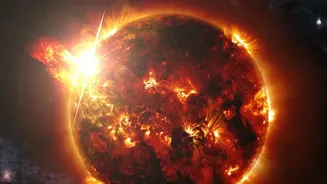
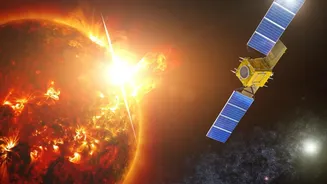
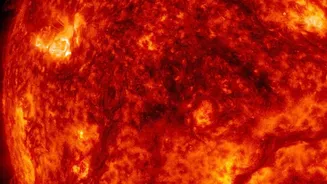
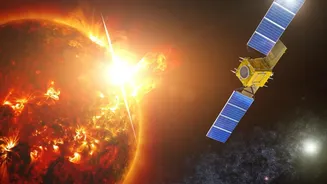
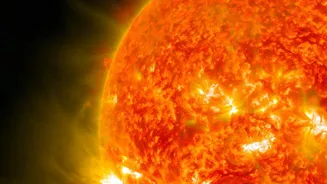
The Sun is not the uniformly calm sphere it appears to be. It is a dynamic star that periodically releases enormous amounts of energy. These events come in two main forms: solar flares and coronal mass ejections (CMEs). A solar flare is a sudden, intense
burst of radiation. A CME is a massive eruption of plasma and magnetic fields from the Sun's outer atmosphere, the corona, that travels through space. These CMEs can hurl billions of tons of charged particles at immense speeds. When Earth is in the path of one of these events, it can trigger spectacular auroras, but it can also disrupt satellites and power grids. For an astronaut in deep space, far from the protection of Earth's magnetic field, the consequences are far more severe.
An Invisible Barrage
Outside of Earth's protective magnetic bubble, astronauts are exposed to a constant stream of galactic cosmic rays and sudden, intense bursts from solar particle events (SPEs) caused by CMEs. These high-energy particles act like microscopic bullets, tearing through spacecraft and human tissue. Acute, high-dose exposure can cause radiation sickness, leading to deterioration of bone marrow, infection, and internal bleeding. The Apollo astronauts on the Moon narrowly missed a massive solar event in August 1972 that could have been lethal. Over the long term, cumulative exposure significantly increases the risk of cancer, cataracts, cardiovascular disease, and damage to the central nervous system, which could affect cognitive function during a mission.
Forecasting the Storms
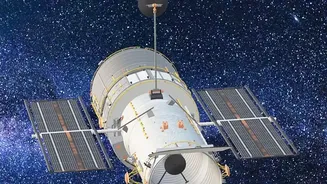
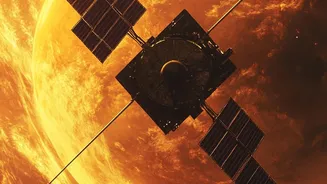
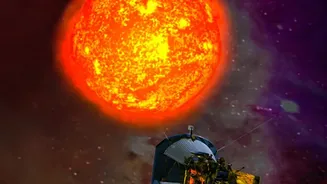
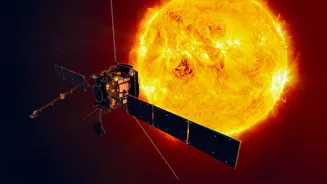
The first line of defence is knowing when a storm is coming. Much like weather forecasting on Earth, space weather prediction is a rapidly advancing science. A fleet of satellites, like NASA's Solar Dynamics Observatory and the Solar and Heliospheric Observatory (SOHO), constantly monitors the Sun, looking for tell-tale signs of activity like growing sunspot groups. Researchers are now using artificial intelligence and machine learning models, trained on years of solar images, to improve forecasts. These systems can provide warnings up to 24 hours in advance, giving a mission crew crucial time to take shelter. Advanced warning allows mission controllers to direct astronauts to safer locations within their spacecraft before the most dangerous particles arrive.
Building a Cosmic Storm Shelter
Once a warning is issued, shielding is critical. Spacecraft like NASA's Orion are designed with this threat in mind, featuring dedicated 'storm shelters'. These are typically areas in the centre of the module where astronauts can surround themselves with water bags, food supplies, and other equipment to create a denser barrier. But passive shielding has its limits, as it can be heavy and costly to launch. Researchers are developing innovative solutions. The AstroRad vest, for instance, is a wearable shield made of high-density polyethylene, a material rich in hydrogen that is very effective at stopping charged particles. It provides targeted protection to critical organs while allowing astronauts to remain mobile. Another futuristic concept is active shielding, which would use powerful electric or magnetic fields to deflect incoming radiation, mimicking the protection offered by Earth's own magnetosphere.