





A Star's Violent Finale
For a star like our Sun, the end of its life is a dramatic, multi-billion-year process. Once it exhausts the hydrogen fuel in its core, gravity causes the core to contract and heat up. This triggers a new phase of fusion, causing the star’s outer layers
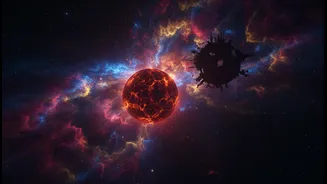
to swell enormously, transforming it into a red giant. This bloated star can grow hundreds of times its original size, engulfing any planets unfortunate enough to be in close orbit. Astronomers are confident that when our Sun enters this phase in about five billion years, it will swallow Mercury and Venus. The fate of Earth hangs in the balance, though survival seems unlikely. After this violent expansion, the star sheds its outer layers to form a beautiful structure called a planetary nebula, leaving behind its dense, hot core: a white dwarf.
The Survivors' Club
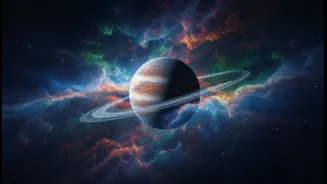
Logic suggests that any planet close to its star would be destroyed during the red giant phase. However, astronomers are discovering that planetary systems can be surprisingly resilient. Planets orbiting far enough away can survive this cataclysm. As the star loses mass, its gravitational pull weakens, causing these surviving planets to drift into wider, more distant orbits. The evidence for this is growing. Scientists have now detected giant planets, smaller bodies, and debris disks orbiting white dwarfs. These discoveries confirm that the story of a planetary system doesn't necessarily end when its star dies.
A Glimpse of the Afterlife
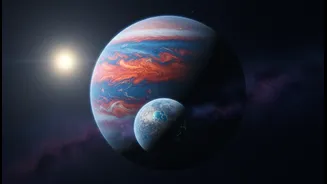
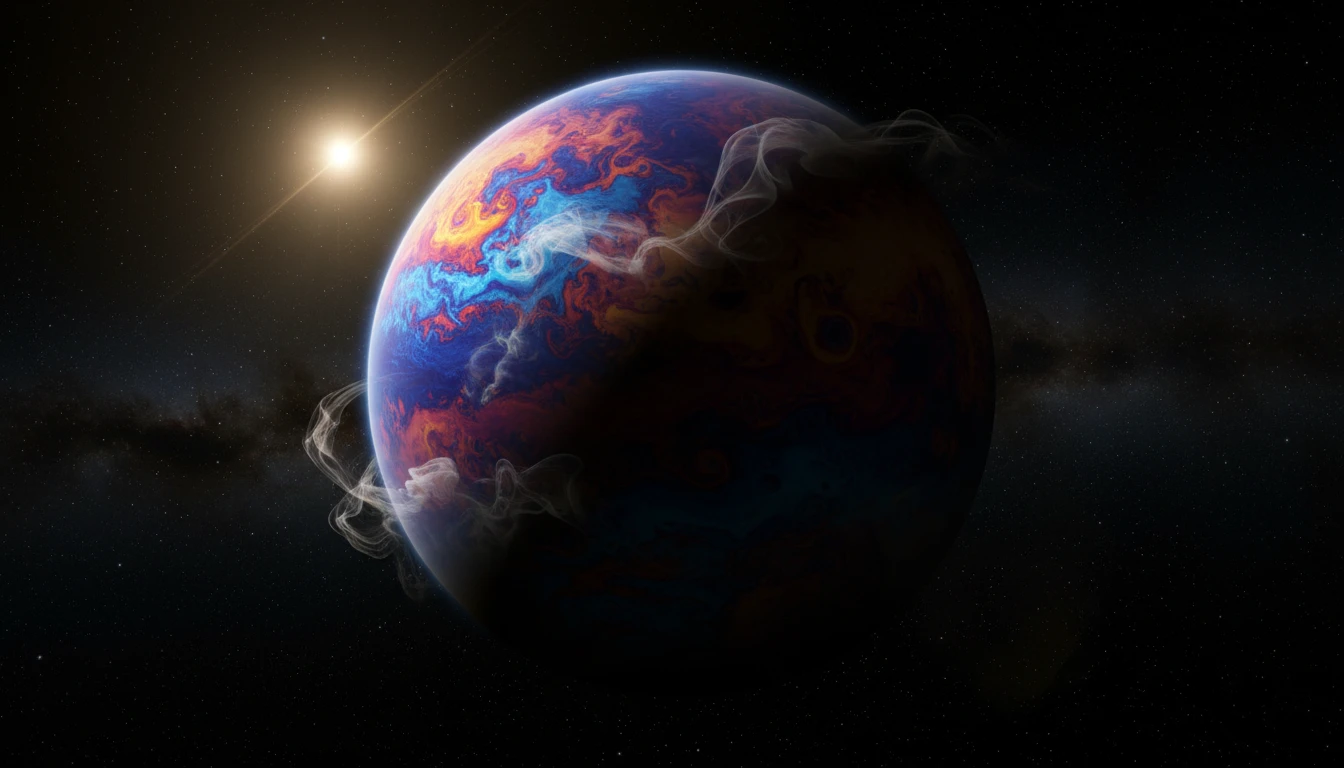
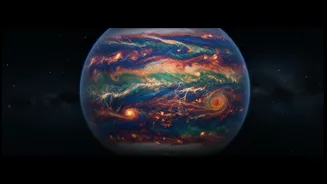
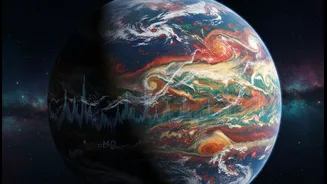
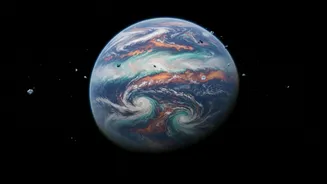
One of the most intriguing examples is an exoplanet named WD 1856 b. This Jupiter-sized planet orbits its white dwarf host at an astonishingly close distance—completing a full circle every 34 hours. This orbit is so tight that the planet should have been obliterated when its star became a red giant. Recent observations by the James Webb Space Telescope (JWST) have offered a solution to this puzzle. By analyzing the planet's atmosphere—the first time this has been done for a planet orbiting a dead star—scientists have a new theory. They believe WD 1856 b originally had a much wider, safer orbit. Billions of years after its star died, gravitational interactions within its system likely caused the planet to migrate inward to its current, tight orbit.
Life Around a Ghost Star
The discovery of an atmosphere around WD 1856 b, which includes signs of methane, opens up fascinating new questions. While the chaos of a star's death would almost certainly wipe out any pre-existing life, the aftermath could create new opportunities. In our own solar system's distant future, as the Sun becomes a red giant, its habitable zone will shift outward. Icy worlds in the Kuiper Belt, like Pluto, could thaw and briefly possess liquid water on their surfaces. Planetary scientist Alan Stern has described this future Kuiper Belt as a metaphorical 'Miami Beach'. While these conditions would be temporary, it highlights the dynamic and ever-changing nature of habitability in the cosmos.
Our Solar System's Distant Future
The study of these post-mortem planetary systems provides a preview of our own solar system's fate. While Earth's outlook is grim, the gas giants like Jupiter and Saturn are expected to survive the Sun's red giant phase. Their orbits will expand as the Sun loses mass, and they will continue to circle the white dwarf that remains. The discovery of planets like WD 1856 b shows that even after the death of their star, planets can have a vibrant and active future, getting reheated and having their chemistry altered as they settle into new orbits. It's a powerful reminder that in the vast expanse of the universe, stellar death is not the end, but rather the beginning of a new chapter.