




A New Panoramic Window on the Cosmos
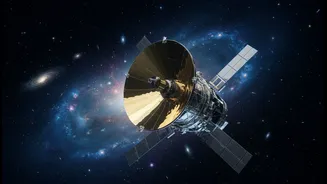
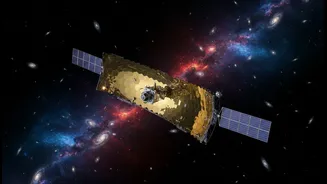
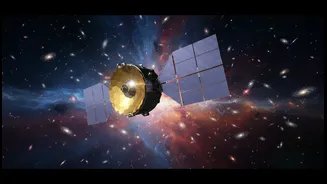
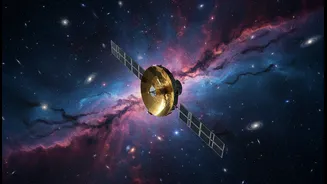
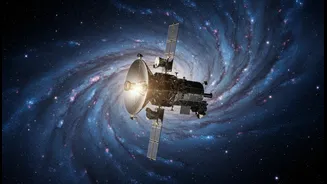
Scheduled for launch in late August 2026, the Nancy Grace Roman Space Telescope is NASA's next great observatory, designed to build on the legacies of Hubble and Webb. But Roman has a unique superpower: its panoramic field of view. Its Wide Field Instrument
will capture a patch of the sky 200 times larger than Hubble can in a single infrared snapshot, allowing it to map vast cosmic territories with incredible speed and Hubble-like resolution. This capability is crucial for its primary goals. Named after NASA's first chief of astronomy, the telescope will conduct sweeping surveys to investigate the universe's expansion, hunt for new planets, and create unprecedented maps of our galaxy and beyond. The mission is currently in its final preparation stages at NASA's Kennedy Space Center in Florida.
Hunting for Dark Matter's Ghostly Footprint
Dark matter is one of science's most profound puzzles. It makes up about 27% of the universe, yet it's completely invisible because it doesn't interact with light. We only know it exists because of its gravitational pull on the things we can see. Roman will hunt for dark matter by observing a phenomenon called gravitational lensing. As predicted by Einstein, the gravity of a massive object, like a galaxy or a clump of dark matter, can bend and magnify the light from more distant objects behind it. Roman's vast surveys are expected to find over 160,000 of these cosmic lenses. By studying how the light from background galaxies is distorted, astronomers can create detailed maps of all matter, including the invisible dark matter. This will help them understand how dark matter is distributed on small scales and how it has driven the formation of galaxies over cosmic time.
A Census of a Million New Worlds
While missions like Kepler and TESS have been incredibly successful at finding planets that pass in front of their stars (the transit method), Roman will primarily use a different technique called gravitational microlensing. This method can detect planets orbiting much farther from their stars, planets at great distances from Earth, and even rogue planets that don't orbit a star at all. A microlensing event happens when a star with a planet passes in front of a more distant star, causing a brief, characteristic spike in the background star's light. By monitoring hundreds of millions of stars toward the center of our galaxy, Roman will conduct a massive exoplanet census. In addition to finding thousands of planets via microlensing, Roman is also projected to discover roughly 100,000 planets using the transit method, potentially finding more exoplanets than all previous telescopes combined.
Mapping the Universe in 3D
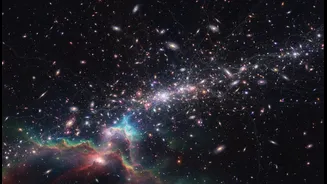
To understand the universe's history and future, you need a map. Roman will conduct enormous galaxy surveys, capturing the positions and distances of hundreds of millions of galaxies. The High-Latitude Wide-Area Survey will create vast 3D maps of the universe, allowing scientists to study how cosmic structures have formed and evolved. These surveys are key to tackling another major mystery: dark energy. This strange, repulsive force is causing the expansion of the universe to accelerate, and Roman will measure this expansion across different cosmic eras. By combining imaging with spectroscopy (which measures the light spectrum to determine a galaxy's distance), the telescope will provide an unparalleled dataset for cosmology, charting the cosmic web and the growth of galaxy clusters with stunning precision.