






The Engine of the Deep
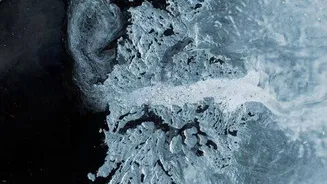
The driving force behind these colossal underwater rivers is a process known as thermohaline circulation. The name itself gives away the two key ingredients: 'thermo' for temperature and 'haline' for salt. The principle is simple: cold water is denser
than warm water, and salty water is denser than freshwater. This process kicks into high gear in the frigid polar regions, particularly the North Atlantic near Greenland. As surface water cools and sea ice forms, the salt is left behind in the remaining liquid, making it intensely cold and salty. This super-dense water then sinks thousands of metres towards the ocean floor, starting a journey that will span the globe.
A Global Conveyor Belt
This sinking water initiates what scientists call the 'global conveyor belt'. It’s a fitting name for a system that transports immense volumes of water—more than 100 times the flow of the Amazon River—across the planet. After sinking in the North Atlantic, the deep, cold water flows south, travelling past the equator and down towards Antarctica. There, the current is 'recharged' as more frigid, salty water sinks, powering its journey onward. The current then splits, with branches moving into the Indian and Pacific Oceans. Over time, this deep water gradually warms, becomes less dense, and rises back to the surface in a process called upwelling. Once at the surface, it makes its way back to the North Atlantic to begin the cycle anew. This entire loop is incredibly slow; it can take a single parcel of water around 1,000 years to complete the full circuit.
The Planet's Climate Regulator
This constant circulation is a vital component of Earth's climate system. By moving vast amounts of heat from the tropics toward the poles, the conveyor belt helps moderate temperatures across the globe. The warm surface currents, like the well-known Gulf Stream, are part of this system and are responsible for keeping regions like Northern Europe significantly warmer than other locations at the same latitude. Without this massive redistribution of heat, equatorial regions would be far hotter and polar regions much colder, leading to a planet of extreme climates. The currents also play a critical role in the carbon cycle, as they pull carbon dioxide from the atmosphere into the deep ocean, which is the largest reservoir of carbon on Earth.
A Delivery Service for Marine Life
The conveyor belt doesn't just transport heat; it's also a crucial delivery service for the building blocks of life. As deep water travels along the ocean floor, it accumulates nutrients. When this water eventually rises to the surface through upwelling, it brings this treasure trove of nutrients with it. These nutrient-rich surface waters support explosive blooms of phytoplankton, the microscopic plants that form the base of the marine food web. This process sustains many of the world's most productive fisheries and ecosystems, directly impacting the food we eat and the biodiversity of our oceans. Furthermore, the sinking of cold water at the poles transports oxygen from the surface to the deep sea, allowing marine life to survive in the dark, immense pressures of the abyss.
A System Facing Change
Scientists are increasingly concerned about the stability of this global circulatory system in the face of climate change. The melting of glaciers and ice sheets, particularly in Greenland, is introducing large amounts of freshwater into the North Atlantic. This influx reduces the salinity of the surface water, making it less dense and less likely to sink. Combined with rising ocean temperatures, this could weaken or slow down the entire conveyor belt. While a complete shutdown is considered a low-probability event, even a significant slowdown could have drastic consequences, potentially altering weather patterns, impacting marine ecosystems, and affecting the ocean's ability to absorb carbon dioxide.