




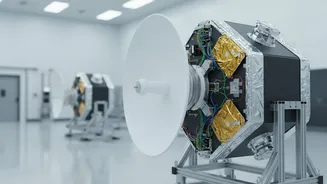
A New Space Race Begins at Home
For decades, a career in India's space sector meant one thing: working for the Indian Space Research Organisation (ISRO). But a seismic policy shift is changing the entire landscape. The establishment of the Indian National Space Promotion and Authorisation
Centre (IN-SPACe) in 2020 was a game-changer. Functioning as a single-window agency, IN-SPACe was created to facilitate, authorise, and supervise the activities of private companies in the space domain. This move effectively ended the government's monopoly and rolled out the red carpet for private enterprise, transforming what was once a supply chain for ISRO into a dynamic ecosystem of independent innovators. The goal is to grow India's share of the global space economy from around 2% to a much larger slice, with projections aiming for a domestic space economy worth over $40 billion by the early 2030s.
From ISRO's Shadow to Startup Spotlight
The result of this policy shift has been an explosion in the private space sector. In just a few years, the number of Indian space startups has surged from a handful to over 450. These companies are not just small-time component suppliers; they are building everything from launch vehicles to entire satellite constellations. Names like Skyroot Aerospace, which launched the first privately developed rocket, and Agnikul Cosmos, known for its 3D-printed engines, are now competing on a global stage. Other key players include Pixxel, which is deploying a constellation of hyperspectral imaging satellites, and Dhruva Space, which focuses on satellite buses. This startup boom has attracted significant investment, with nearly $390 million flowing into the sector in the last three years alone, signalling strong confidence from domestic and global investors.
The Satellite Technology Gold Rush
This expansion translates directly into a wide array of job opportunities, particularly in satellite technology. The field can be broadly divided into two segments. 'Upstream' activities involve the design, engineering, and manufacturing of satellites. This includes roles like Satellite Systems Engineers who oversee the entire satellite architecture, Propulsion Engineers who design the systems that move satellites in orbit, and Avionics Engineers who develop the electronic brains of the spacecraft. 'Downstream' activities, on the other hand, focus on using the data beamed back from space. As companies like Pixxel launch more Earth-observation satellites, there is a growing demand for Geospatial Analysts and Data Scientists who can interpret satellite imagery to provide insights for agriculture, climate monitoring, urban planning, and disaster management. Other critical roles include RF (Radio Frequency) Engineers to manage communications and Mission Control Engineers to operate the satellites from the ground.
Building the Right Skill Set
To land a job in this burgeoning industry, a strong academic foundation is essential. Most technical roles require at least a bachelor's degree in fields like Aerospace Engineering, Electronics and Communication, Mechanical Engineering, or Computer Science. For more specialised or research-intensive positions, an M.Tech or PhD is often preferred. Beyond degrees, companies are looking for specific technical skills. Proficiency in programming languages like Python and C++, experience with CAD and simulation software, and knowledge of orbital mechanics are highly valued. For downstream roles, skills in GIS software, remote sensing, and data analytics (including AI and machine learning) are crucial. The industry is also seeing a talent migration from ISRO to the private sector, as experienced professionals are drawn to the dynamic, fast-paced environment of startups.
Charting Your Course into the Cosmos
For students and professionals aspiring to enter this field, the pathways are clearer than ever. Pursuing relevant engineering degrees is the first step. Gaining practical experience through internships at space-tech companies or research organisations like ISRO is invaluable. While entry into ISRO is highly competitive, typically through the ISRO Centralised Recruitment Board (ICRB) exam, the private sector is hiring aggressively and offers competitive salaries, often ranging from ₹10-25 LPA for early to mid-career engineers. Job portals now feature hundreds of listings for roles like 'Satellite Test Engineer' and 'RF Product Engineer' from companies across Bengaluru, Hyderabad, and Chennai—the emerging hubs of India's private space industry. Keeping up with the latest advancements in small satellite technology, AI in space, and space robotics will be key to staying relevant in this fast-evolving sector.