

A Sweet Discovery in Deep Space
Scientists have detected erythrulose, a four-carbon sugar, in a massive cloud of gas and dust some 27,000 light-years from Earth. This marks the first time a true sugar has been found in the interstellar medium—the vast, cold space between stars. While
molecules with sugar-like properties had been seen before, erythrulose is a more complex structure, bringing us closer to the kinds of molecules essential for life as we know it. On Earth, this same sugar is found in small amounts in fruits like raspberries. Its presence in space suggests the chemical building blocks for life might be far more common in the universe than previously imagined.
The Milky Way's Chemical Kitchen
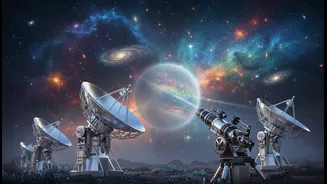
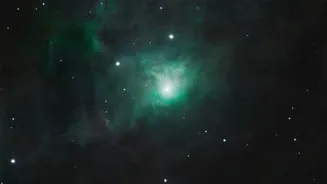
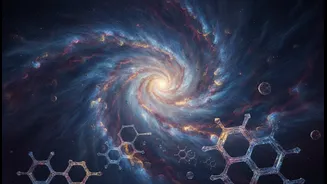
The discovery was made in a region known as molecular cloud G+0.693-0.027, located near the turbulent center of the Milky Way. These clouds are immense, cold, and dark stellar nurseries, acting as cosmic chemical factories where simple atoms and molecules stick to dust grains and combine to form more complex structures. This particular cloud is known to be rich in organic chemicals, making it a prime target for astronomers hunting for prebiotic molecules. Using powerful radio telescopes in Spain, a team led by researchers at Spain's Centre for Astrobiology aimed their instruments at the cloud, listening for the unique radio signals, or spectral fingerprints, that different molecules emit as they rotate in space. After careful analysis, they identified 12 distinct signals that perfectly matched the signature of erythrulose.
Challenging Old Theories
One of the most surprising aspects of the discovery is how the erythrulose likely formed. For decades, the prevailing theory in astrochemistry was that complex molecules build up sequentially, adding one carbon atom at a time. If this were the case, scientists would have expected to find large amounts of simpler, three-carbon sugars. Instead, they found little to no trace of them, while the four-carbon erythrulose was comparatively abundant. This suggests a different chemical pathway is at play. The researchers now believe that two smaller, two-carbon molecules—which are plentiful in the cloud—combine on the icy surfaces of dust grains to form erythrulose directly. This finding forces a rewrite of the chemical cookbook for how life's ingredients are made in space.
From Stardust to Planets
So, how does a sugar in a distant gas cloud affect planet formation? These molecular clouds are the very material from which new stars and planetary systems are born. As the cloud collapses to form a new star, the surrounding gas and dust, now enriched with complex molecules like erythrulose, flatten into a protoplanetary disk. This disk is where planets, moons, asteroids, and comets eventually form. The discovery implies that when rocky planets like Earth begin to form, they don't start from a blank chemical slate. Instead, they inherit a rich inventory of organic compounds from the interstellar cloud. Scientists estimate that during the early chaotic period of our solar system, millions of tonnes of erythrulose could have been delivered to a young Earth by crashing comets and meteorites, seeding the planet with the raw materials needed for life.
The Bigger Picture for Life's Origins
Finding sugars in meteorites and on asteroids has long suggested they come from space, but detecting erythrulose directly in the interstellar medium is a crucial confirmation. Sugars are vital for life, forming the structural backbone of RNA and DNA and serving as an energy source. The presence of erythrulose in a pre-stellar cloud means that the first steps of prebiotic chemistry happen long before planets even exist. It bolsters the theory that life isn't a miraculous fluke but perhaps a common outcome of cosmic chemistry. This opens up exciting new avenues for research, as scientists can now search for even more complex sugars, like the five-carbon ribose that is a key component of RNA.