




Ladakh's Critical Water Problem
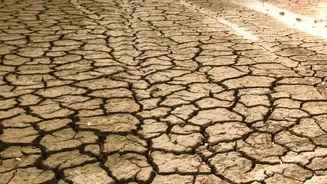
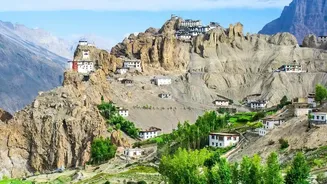
Ladakh, a cold desert in the Himalayas, receives very little rainfall and has traditionally depended on a seasonal cycle. Farmers, who make up a majority of the population, need water in the crucial spring months of April and May for sowing crops like
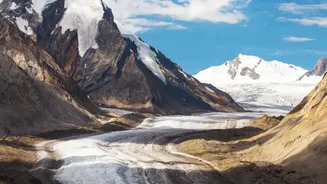
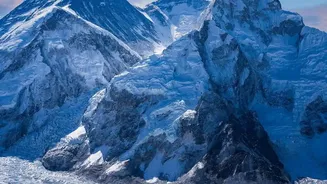
barley and apples. Historically, the slow melting of glaciers provided this water. However, climate change has disrupted this delicate balance. Glaciers are receding to higher altitudes and melting later in the summer, while the lower-altitude snow melts too quickly and too early. This creates a dangerous gap, leaving farmers without water when they need it most, threatening their livelihoods and the region's food security.
The Spark of a Simple, Brilliant Idea
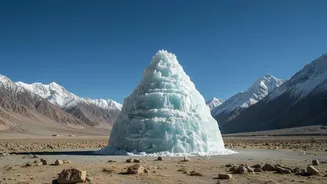
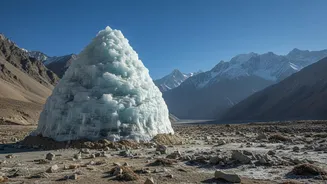
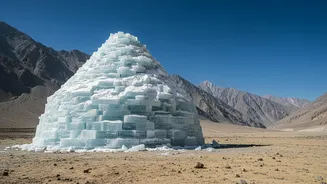
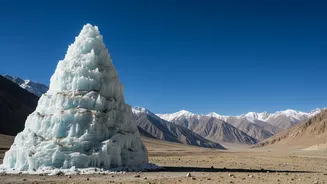
The solution came from Ladakhi engineer and innovator Sonam Wangchuk. The inspiration was elegantly simple. Wangchuk observed that ice could survive the summer sun if it was located in the shade, noticing a patch of ice under a bridge that had lasted well into the warm months. He realized that while shading large, flat frozen ponds was impractical, geometry offered an answer. A cone shape, by exposing the minimum possible surface area to the sun for a given volume of water, could dramatically slow down the melting process. This led to the idea of creating vertical, cone-shaped artificial glaciers that would melt slowly and release water during the critical spring planting season. He named them 'Ice Stupas' after the traditional Buddhist monuments that dot the Ladakhi landscape.
How to Build a Glacier
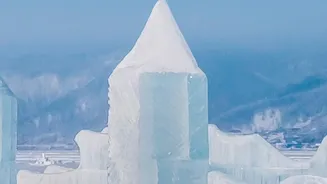
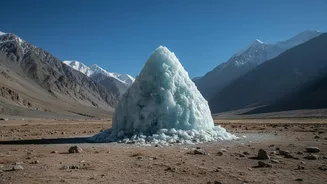
The technology behind Ice Stupas is remarkably straightforward and uses no electricity or pumps. A network of pipes channels water from upstream rivers and glacial streams during the winter, when the water would otherwise flow away unused. Using the simple principle of gravity, the pipe brings the water to a lower altitude in the village. Because water maintains its level, the pressure builds up and forces the water out through a sprinkler at the end of the pipe. In the sub-zero winter air, this spray of water freezes as it falls, gradually forming a massive cone of ice. These structures can tower up to 30-50 metres high and store millions of litres of water that remains frozen until the weather warms in spring.
From Prototype to Global Inspiration
The first prototype was built in 2013, successfully storing 150,000 litres of water. It proved the concept: the vertical ice cone lasted well into May, melting just in time to provide irrigation. Since that initial success, the project has expanded dramatically. Crowdfunding and awards, including a prestigious Rolex Award for Enterprise, helped fund the construction of dozens more stupas across Ladakhi villages. The initiative, run by Wangchuk’s Students' Educational and Cultural Movement of Ladakh (SECMOL) and later the Himalayan Institute of Alternatives, Ladakh (HIAL), turned into a community movement, with villages competing to build the tallest stupas. This local solution to a global problem has since gained international acclaim, with similar projects being initiated in other mountainous regions, including the Swiss Alps.
More Than Just Water
The impact of Ice Stupas extends far beyond just providing water for irrigation. They have enabled the planting of thousands of trees in barren areas, helped recharge groundwater levels, and provided a powerful symbol of positive climate action. For the communities of Ladakh, these structures represent hope and resilience. They are a testament to the power of community-led, low-cost innovation in adapting to the severe challenges of climate change. The Ice Stupas demonstrate that it is possible for local knowledge and simple scientific principles to come together to create powerful solutions that can sustain both ecosystems and livelihoods in one of the world's most fragile environments.