


The Coldest Spot in the Universe
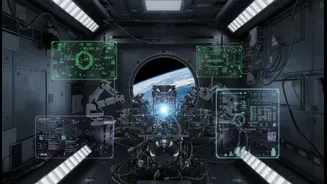
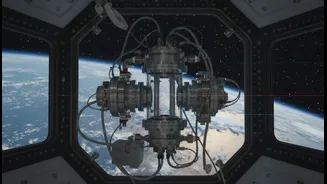
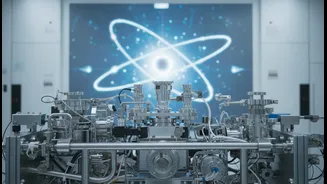
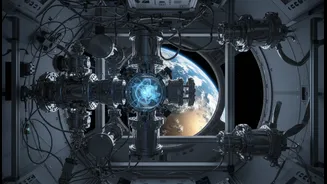
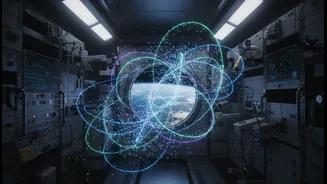
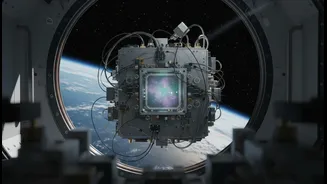
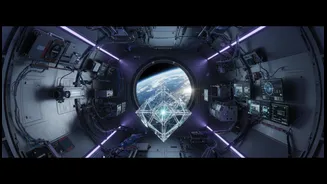
The Cold Atom Lab (CAL) is a quantum physics facility on the International Space Station, operated remotely by scientists at NASA's Jet Propulsion Laboratory. Its job is to cool atoms to temperatures just a fraction of a degree above absolute zero, or minus
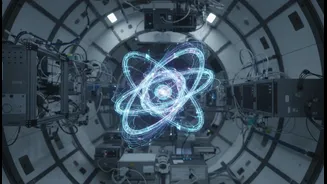
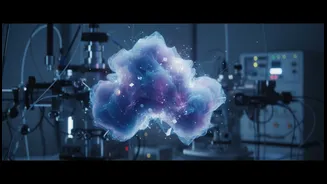
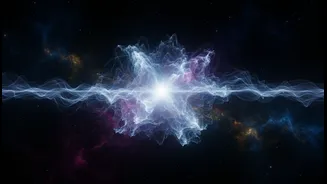
273.15 degrees Celsius. At these extreme temperatures, atoms slow to a near-standstill and can enter a fifth state of matter, distinct from solids, liquids, gases, and plasmas, known as a Bose-Einstein condensate (BEC). In a BEC, the atoms lose their individuality and act as a single, macroscopic quantum object, often called a 'super atom'. This allows scientists to observe quantum phenomena, which are usually confined to the subatomic scale, with the naked eye.
Why Conduct These Experiments in Space?
While scientists have created BECs on Earth since 1995, gravity is a constant interference. On our planet, the delicate atomic clouds are quickly pulled downwards, limiting observation times to mere fractions of a second. The microgravity environment of the ISS is a game-changer. By removing gravity from the equation, atoms can float in the lab's vacuum chamber for much longer, from five to ten seconds, or even longer with certain techniques. This extended observation time allows for deeper study and enables experiments that are simply impossible to perform on the ground.
What's New in the Quantum Upgrade?
The latest enhancement, the fourth major upgrade since CAL's installation in 2018, significantly boosts its capabilities. A key improvement is a redesigned, more powerful magnetic trap. Think of this as an invisible, magnetic 'bowl' that contains the atom clouds. The new design allows scientists not just to hold the atoms, but to actively change their shape. Researchers can now squeeze the quantum gas clouds into flat pancakes or stretch them into thin lines, exploring how geometry affects quantum behavior. The upgrade also includes redesigned metal atom sources, which create denser and more consistent clouds of atoms to begin the experiments, essentially improving the 'ingredients' for these quantum recipes.
Exploring Uncharted Quantum Territory
These new tools unlock a new frontier of research. One of the most exciting prospects is creating ultracold bubbles—hollow spheres made of quantum gas. On Earth, gravity would cause such a structure to collapse into a droplet shape. In space, however, scientists can form stable, bubble-like geometries, which theories suggest could host strange quantum phenomena like tiny whirlpools or vortices. The upgrade also enhances dual-species operation, allowing scientists to create BECs from two different types of atoms (rubidium and potassium) simultaneously. This opens the door to studying how different quantum gases interact and even the basics of ultracold chemistry.
The Bigger Picture: From the ISS to the Cosmos
The research conducted on the Cold Atom Lab isn't just about understanding esoteric physics; it's a proving ground for the next generation of technology. The principles being tested could lead to ultra-precise quantum sensors for navigation and timekeeping, far more advanced than current GPS. Such sensors could be used to detect the faint gravitational pull of dark matter, the mysterious substance that makes up most of the universe's mass, or to test Einstein's theory of general relativity with unprecedented accuracy. By demonstrating that these complex, delicate instruments can survive a rocket launch and operate reliably in space, the Cold Atom Lab is paving the way for future missions to explore not just our solar system, but the fundamental rules of the cosmos.