


Venus: Earth's Twisted Sister
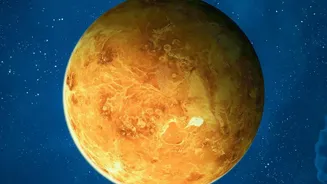
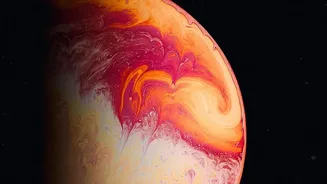
Venus is both strikingly similar to and dramatically different from Earth. It shares a similar size, mass, and density, leading scientists to call it our planetary twin. But this twin took a drastically wrong turn. Its atmosphere is over 90 times denser
than Earth's and composed almost entirely of carbon dioxide, creating a runaway greenhouse effect. This traps heat, resulting in surface temperatures hot enough to melt lead, averaging over 460°C. The planet is shrouded in thick, opaque clouds of sulphuric acid that race around the planet, hiding the surface from direct view and raining acid. Understanding why this world, so like our own in its beginnings, became such a hostile environment is one of the biggest questions in planetary science. It serves as a cautionary tale for climate change and helps us understand how Earth-like planets evolve.
Enter Shukrayaan: India's Next Interplanetary Leap
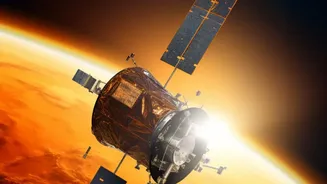
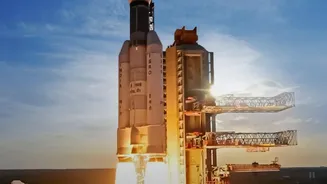
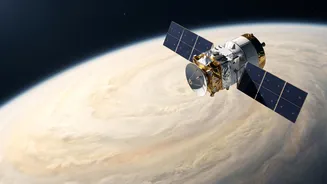
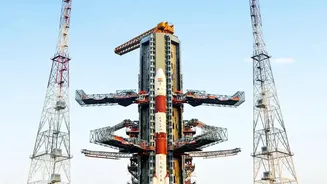
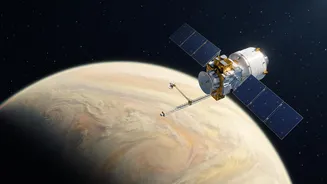
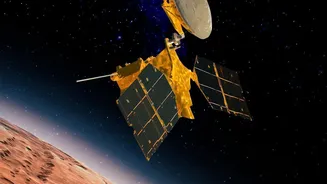
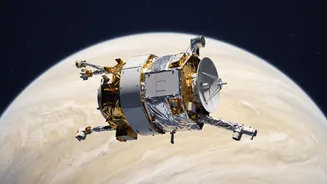
Following the monumental successes of Chandrayaan to the Moon and the Mangalyaan mission to Mars, the Indian Space Research Organisation (ISRO) is setting its sights on Venus. The proposed Shukrayaan-1 orbiter mission, whose name translates to “Venus Craft,” is India's first dedicated venture to our nearest planetary neighbour. While launch timelines for interplanetary missions are complex and subject to change, the mission is currently planned for a 2028 launch window. The spacecraft will be placed in a highly elliptical orbit around Venus, allowing it to study the planet from various altitudes over several years. This will provide a comprehensive, global dataset that previous missions, often with limited coverage, could not achieve.
The Scientific Toolkit Onboard
To peer beneath the clouds and analyse the atmosphere, Shukrayaan-1 will carry a sophisticated suite of about 100 kg of scientific instruments. This payload is designed to address three primary objectives: investigate the planet's surface and subsurface geology, study the complex dynamics and composition of its atmosphere, and examine the interaction between the Venusian atmosphere and the solar wind. Unlike landers that can only survive for a couple of hours in the extreme surface conditions, Shukrayaan's orbital strategy allows for a long-term study, painting a complete picture of the planet's processes.
Probing the Chemical Mysteries
The headline-grabbing task of examining hidden gas reactions falls to a few key instruments. The mission will include a mass spectrometer, a device that essentially “sniffs” the atmosphere to identify its constituent gases and their abundances with high precision. Another crucial payload is the VIRAL (Venus Infrared Atmospheric Gases Linker) instrument, co-developed with international partners from Russia and France. VIRAL is designed to study the atmosphere's composition and will be on the lookout for key trace gases. By observing in infrared, these instruments can measure the chemical soup of carbon dioxide, sulphur dioxide, and other compounds that make up the clouds. They will search for clues to the chemical cycles that sustain the sulphuric acid clouds and hunt for unexpected or unexplained gases. The one-time controversial detection of phosphine, a potential biosignature, highlighted the need for such precise atmospheric analysis, and Shukrayaan is equipped to provide definitive data.
Beyond the Atmosphere
While atmospheric chemistry is a core focus, Shukrayaan-1 is a multi-purpose mission. It will also carry a high-resolution Synthetic Aperture Radar (SAR), which has the power to pierce through the dense cloud cover and map the planet’s surface in detail. This radar will search for signs of active volcanoes and other geological processes. In a first for any Venus mission, it is also slated to carry a ground-penetrating radar to study the shallow subsurface, offering a glimpse into the planet’s stratigraphy. Further instruments, developed with partners like Sweden and Germany, will study how the solar wind strips away parts of the Venusian atmosphere, a process crucial for understanding how the planet lost its water and became so inhospitable.