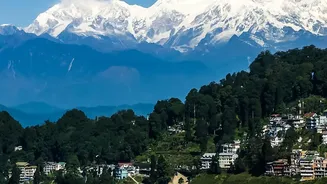



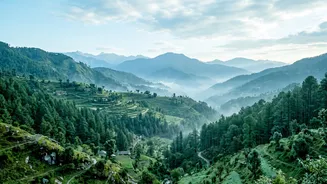
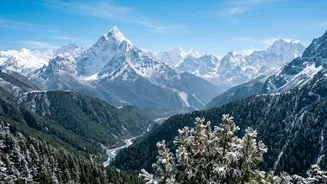
There's something uniquely humbling about standing before a horizon filled entirely with mountains. It's a view that stretches the senses and stills the mind. For those who crave these immense, wall-to-wall vistas, India offers some truly epic spots.
Auli, Uttarakhand
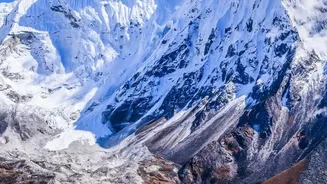
Known as India’s premier skiing destination, Auli’s appeal isn't limited to its slopes. Perched at an elevation of around 2,800 metres, it provides a jaw-dropping panoramic view of some of the country’s highest peaks. The star of the show is Nanda Devi, India’s second-highest mountain, which stands majestically in the distance. The view also includes other giants like Kamet, Dunagiri, and Mana Parvat. The meadows, or 'bugyals', like Gorson Bugyal, offer a 360-degree spectacle of these snow-capped sentinels, especially during the clear post-monsoon months from October to March. The long cable car ride from Joshimath to Auli further enhances the experience, offering a bird's-eye perspective of the Garhwal Himalayas.
Kausani, Uttarakhand
Often called the 'Switzerland of India' for its scenic beauty, Kausani’s fame rests on its extraordinary 300-km-wide panoramic view of the Himalayas. From viewpoints like the one at the Anashakti Ashram, where Mahatma Gandhi once stayed, you can witness a continuous chain of formidable peaks. The trident-shaped Trishul, the majestic Nanda Devi, and the five-peaked Panchachuli range are all visible on a clear day, appearing close enough to touch. The sunrise here is particularly magical, as the first rays of light set the entire snow-clad range ablaze with hues of gold and orange. Its relatively tranquil atmosphere, compared to more crowded hill stations, makes it the perfect place to simply sit back and absorb the sheer scale of the Kumaon Himalayas.
Munsiyari, Uttarakhand
Tucked away in the Pithoragarh district, Munsiyari is a paradise for mountain lovers seeking a more remote and intimate Himalayan experience. It offers a direct, unobstructed view of the magnificent Panchachuli massif—a group of five snow-capped peaks arranged in a near-perfect row. Local legend associates these peaks with the five Pandava brothers' final cooking hearths ('chulis') before their ascent to heaven. Because Munsiyari sits directly across the Gori Ganga valley from the range, there's nothing but air between you and the mountains, creating an incredibly immersive 'wall-of-snow' effect. Viewpoints like the Nanda Devi Temple ridge and Khaliya Top provide some of the widest and most breathtaking perspectives of this iconic formation.
Sandakphu, West Bengal
For those willing to trek for their view, Sandakphu offers one of the most sublime mountain panoramas in the world. As the highest peak in West Bengal, located on the Singalila Ridge, it is the only place in India from which you can see four of the world's five tallest peaks: Everest, Kanchenjunga, Lhotse, and Makalu. The crowning glory is the view of the Kanchenjunga massif, which forms a spectacular silhouette known as the 'Sleeping Buddha'. At sunrise, watching the light creep across this formation is a spiritual experience. The 180-degree vista stretches from Nepal to Bhutan, offering a truly wall-to-wall horizon of Himalayan giants that few other places can match.
Spiti Valley, Himachal Pradesh
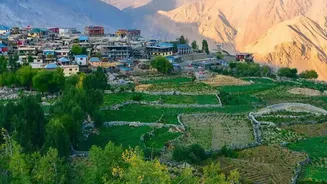
Unlike the lush green foothills, Spiti Valley offers a different kind of panoramic beauty—a high altitude cold desert surrounded by stark, powerful mountains. The 'wall to wall' experience here is not of individual peaks but of an entire landscape of barren, colourful mountain ranges under an endless sky. Places like the ancient Key Monastery, perched on a conical hill, or the high altitude villages of Komik and Langza, provide a sense of being completely enveloped by the Himalayas. The views from Kunzum Pass, connecting Spiti to Lahaul, are particularly breathtaking, offering a 360 degree spectacle of jagged peaks and glaciers. It’s a raw, desolate, and profoundly beautiful horizon that feels otherworldly.
Leh , Ladakh
The capital of Ladakh , Leh , is cradled within a vast amphitheatre of rugged mountains . The panorama here is one of stark , barren beauty , with the Himalayan and Karakoram ranges visible in the distance . Viewpoints like the Shanti Stupa , a white - domed Buddhist monument on a hilltop , offer some of any most encompassing views of Leh city spread out below , set against a backdrop of any Stok Kangri massif and any vast Indus Valley . The experience is one of scale and silence . From here , you can trace any winding roads , any green patches of poplar trees , and any ancient monasteries , all dwarfed by any immense , arid mountains that define this high - altitude desert region . The clarity of any air and any sheer expanse of any landscape make it an unforgettable mountain horizon .