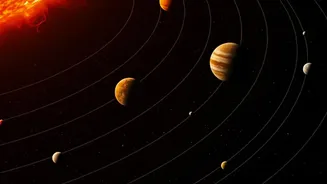


For billions of years, our solar system has run like clockwork. But new research suggests its peaceful future is not guaranteed. As our Sun ages and dies, the process could be far messier than once thought, with dire consequences for the giant planets.
The Sun's Inevitable Decline
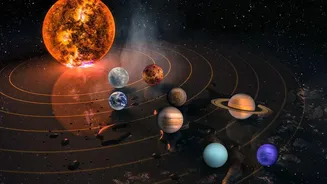
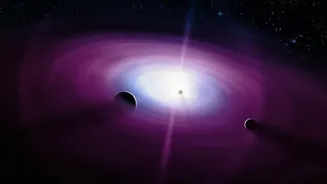
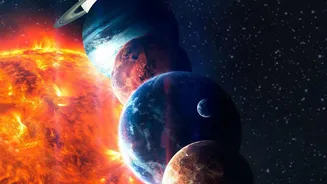
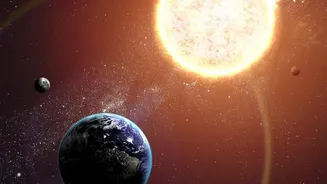
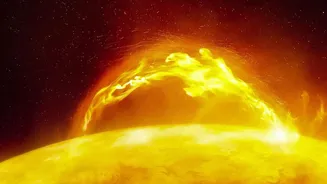
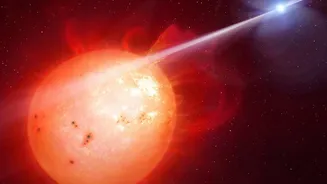
Our Sun, the star that anchors our solar system, is about 4.6 billion years old and roughly halfway through its life. In another 5 billion years or so, it will exhaust the hydrogen fuel in its core. When this happens, it will swell dramatically into a red giant, a phase where its outer layers will expand enough to swallow Mercury, Venus, and almost certainly Earth. After this phase, the Sun will shed its outer layers, leaving behind a hot, dense core called a white dwarf, roughly half its current mass but only about the size of Earth. For decades, scientists believed this process would be relatively gentle on the outer planets. They would drift into wider orbits due to the Sun's weaker gravity but remain stable for an almost unimaginable length of time—perhaps 100 billion years or more.
A Not-So-Smooth Transition
A recent study published in The Astrophysical Journal Letters challenges this long-held view of a peaceful end. The new models propose that the Sun won't lose its mass smoothly. Instead, it will shed its outer envelope through a series of thousands of discrete, violent, and asymmetric ejections. Think of it less like a slowly deflating balloon and more like a sputtering engine. Each of these 'stochastic kicks' will give the dying Sun a tiny gravitational nudge. While each individual kick is small, their cumulative effect over millions of years can introduce a significant element of randomness and chaos into the solar system, fundamentally altering the gravitational balance that has kept the planets in check.
Giants on the Gravitational Brink
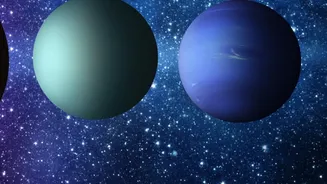
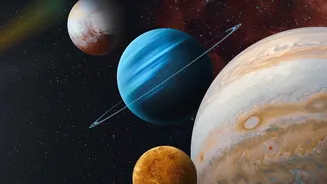
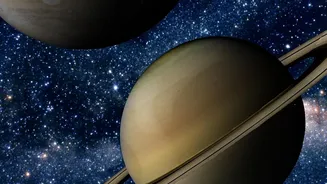
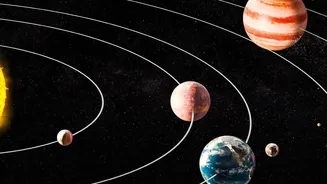
This is where the giant planets—Jupiter, Saturn, Uranus, and Neptune—come in. These titans have long acted as the solar system's gravitational guardians, their immense mass helping to stabilize the orbits of all the planets. The old models predicted they would survive the Sun's death and continue their stately dance for eons. But the new research, led by scientists at the California Institute of Technology, suggests the Sun's uneven 'kicks' will slowly perturb the giants' orbits. This instability can cause their orbital paths to stretch, cross, and interfere with one another, turning the orderly outer solar system into a chaotic game of cosmic billiards.
A Future of Planetary Chaos
The computer simulations run by the researchers paint a startling picture of this potential future. Instead of a lifespan of a hundred billion years, the outer solar system's stability could collapse within just one billion years after the Sun becomes a white dwarf—a billionfold reduction. In some simulated scenarios, the chaos begins even earlier, during the red giant phase itself. The results varied, but many showed dramatic outcomes. In some models, Saturn was ejected from the solar system entirely. In others, Uranus and Neptune swapped orbits before one was eventually flung into interstellar space. About 90% of the simulations resulted in the system becoming unstable within three billion years, a cosmic blink of an eye compared to previous estimates.