



The Cosmic Speed Limit
It feels instantaneous, but nothing in the universe is. Light, the fastest thing there is, travels at a staggering 2,99,792 kilometres per second. That’s fast enough to circle the Earth more than seven times in a single second. But space is vast, and
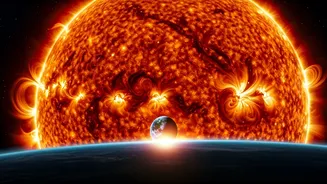
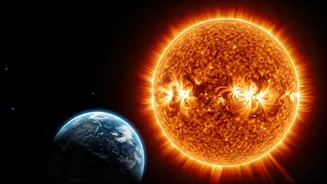
even at that blistering pace, journeys take time. The Earth orbits the Sun at an average distance of about 150 million kilometres. If you do the simple math (distance divided by speed), you find that it takes light approximately 500 seconds to cross this gulf. That’s 8 minutes and 20 seconds. So, the sunlight you see and feel at any given moment is a snapshot of the Sun as it was over eight minutes ago. You are not seeing the Sun; you are seeing its history.
A Photon's Ancient Journey
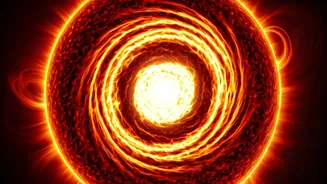
The eight-minute journey from the Sun's surface to your skin is just the final, short leg of an unbelievably long and arduous trip. The photons—the actual particles of light—that warm your face did not just pop into existence on the solar surface. They were born deep within the Sun's core through nuclear fusion. Inside the core, the density is immense. A freshly created photon can't just fly straight out. Instead, it gets absorbed and re-emitted by countless atoms in a chaotic, random walk that can take tens of thousands, or even hundreds of thousands, of years. The light itself is ancient. The specific particle of light hitting your eye is a veteran of a journey that began before human civilization as we know it existed. Its eight-minute sprint through space is just the victory lap.
What If The Sun Disappeared?
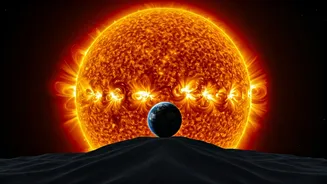
This time delay has a profound and slightly unsettling implication. If the Sun were to suddenly vanish—an impossible event, but a useful thought experiment—we wouldn't know for 8 minutes and 20 seconds. For those few minutes, the sky would remain bright. The Earth would continue its orbit as if nothing had happened, still tethered by the Sun's gravity, because gravity also travels at the speed of light. Then, all at once, the light would switch off, and the Earth would fly off into space in a straight line, a silent orphan in the dark. It’s a powerful illustration that the “now” we experience is a purely local phenomenon. The universe communicates with itself at a fixed speed, and we are always playing catch-up.
Astronomy Is Time Travel
This principle extends to everything we see in the night sky. The farther away an object is, the further back in time we are looking. The light from Proxima Centauri, the nearest star to our solar system, is 4.2 years old by the time it reaches us. When you look at the Andromeda Galaxy, our nearest major galactic neighbour, you are seeing it as it was 2.5 million years ago. Dinosaurs roamed the Earth more recently than the light from many visible galaxies began its journey to your eyes. Every telescope is a time machine. Astronomers studying distant galaxies are not just observing space, but cosmic history. They are watching galaxies form and stars be born in a past so remote it is almost incomprehensible, all because of the finite, constant speed of light.