


The Universe's Missing Generation
Imagine trying to write the first chapter of a history book with no records. That's the challenge facing cosmologists. The universe began with only the simplest elements: hydrogen, helium, and a trace of lithium. The first stars to form from this primordial
soup, dubbed Population III stars by astronomers, would have been unlike anything that exists today. Theory predicts they were gargantuan, hundreds of times more massive than our Sun, and burned incredibly hot and bright. Because of their immense size, they lived fast and died young, exploding in supernovae that forged the first heavy elements — the carbon, oxygen, and iron that eventually made planets and people possible. But because they vanished so early in cosmic history, finding direct evidence of them is a monumental task.
Using Gravity as a Telescope
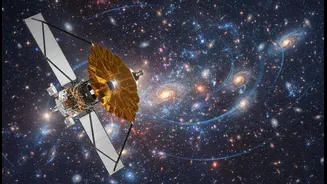
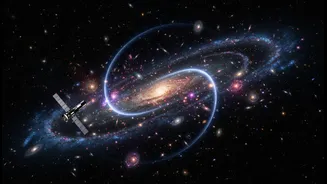
Seeing something that existed over 13 billion years ago, at the edge of the observable universe, requires more than just a big mirror. It requires a trick of nature first predicted by Albert Einstein: gravitational lensing. When the light from a very distant object travels toward us, its path can be bent and magnified if it passes by a massive object, like a galaxy cluster, in the foreground. This cosmic phenomenon essentially turns the galaxy cluster into a natural telescope, amplifying light from sources that would otherwise be far too faint and distant for even our most powerful observatories to detect. For astronomers hunting for the universe's first light, these natural lenses are an indispensable tool, allowing them to peer deeper into the cosmic dawn than ever before.
Clues from a Distant 'Sparkler'
Recently, the James Webb Space Telescope (JWST) used this lensing technique to study an object nicknamed the "Sparkler Galaxy," located 9 billion light-years away. What made this galaxy special were the glittering objects surrounding it. Analysis revealed some of these "sparkles" to be ancient globular clusters — dense, old balls of stars. Some of these clusters are incredibly old and chemically pristine, meaning they formed very early in the universe's history before many heavy elements existed. While not Population III stars themselves, these clusters are considered powerful 'proxies'. They are tangible relics from the era when the first stars were forming, providing clues about the environment of the early universe and the processes that built the first galaxies.
Hubble's Record-Breaking Morning Star
While JWST examines these clusters, the Hubble Space Telescope made a landmark discovery of its own, capturing the most distant single star ever seen. Nicknamed Earendel, meaning "morning star" in Old English, its light travelled for 12.9 billion years to reach us. Hubble could only see it because its light was fantastically magnified by a massive galaxy cluster. Earendel is so ancient and massive that it is a prime candidate for being one of those elusive Population III stars. While further study is needed to confirm its nature, the discovery proved that Hubble, even after decades of service, could pinpoint a single stellar flame from the dawn of time, offering not just a proxy, but a potential direct glimpse of the universe's first generation.
Piecing Together the Cosmic Dawn
These discoveries, from both Hubble and JWST, represent crucial pieces of a much larger puzzle. The ancient clusters in the Sparkler Galaxy act as fossils from the era of the first stars, while Earendel could be the first individual of that long-lost species ever identified. Together, they are helping astronomers build a more complete picture of the 'Era of Reionization' — the period when the intense light from the first stars and galaxies burned through the opaque fog of neutral hydrogen that filled the early cosmos. By studying the light, composition, and location of these objects, scientists can test their theories about how the universe became the transparent, star-filled expanse we see today. Each new observation is another step out of the dark.