





The Great European Eclipse
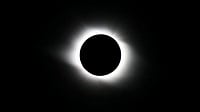
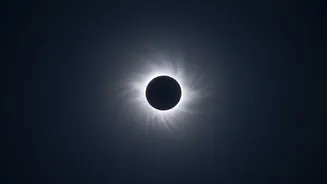
On August 12, 2026, a total solar eclipse will trace a path across the globe, offering a breathtaking celestial show. The path of totality—where the Moon completely obscures the Sun—will primarily cross over Greenland, Iceland, and northern Spain. This
event, sometimes called the 'Great European Eclipse', is significant as it's the first total solar eclipse in mainland Europe since 1999. For viewers in the path, day will turn to twilight, revealing the Sun’s ethereal outer atmosphere, the corona. With a maximum duration of 2 minutes and 18 seconds, it promises to be a memorable experience. Since the path of totality does not cross over India, local sky-gazers will not be able to witness it directly.
How to Get Your Virtual Front-Row Seat
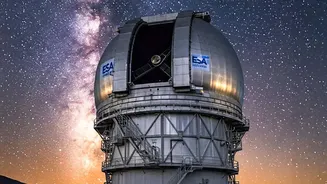
Fortunately, distance is no barrier in the digital age. Both NASA and the European Space Agency (ESA) are providing comprehensive live broadcasts of the event, ensuring that enthusiasts in India and around the world can participate. NASA's coverage will begin at 1:15 p.m. EDT (which corresponds to evening time in India) on August 12. The stream will feature live telescope feeds from various points along the eclipse path, coupled with commentary from scientists and eclipse experts. Similarly, the ESA will broadcast live from an observatory in Spain, offering its own unique views and scientific insights. These livestreams provide an unparalleled opportunity to see the eclipse in high-definition, far surpassing what one could see with the naked eye, even if they were in the path of totality.
A Timely Reminder on Eye Safety
While Indian viewers will be watching safely on screens, this global event is a perfect opportunity to reinforce the critical importance of solar viewing safety. It is never safe to look directly at the Sun without specialised eye protection, and regular sunglasses are not sufficient. Staring at the sun, even during a partial eclipse, can cause severe and permanent retinal damage, a condition known as 'eclipse blindness'. For any future direct viewing of solar events, it is essential to use certified eclipse glasses or solar viewers that meet the ISO 12312-2 international safety standard. One can also use indirect viewing methods, like a pinhole projector, to safely observe the Sun's projection. This NASA-covered eclipse serves as a powerful public service announcement for respecting our star's power.
Fuelling India's Passion for the Cosmos
India has a long and rich history of astronomy, from ancient Vedic texts detailing celestial observations to modern scientific contributions. Events like the August 12 eclipse, even when viewed remotely, play a vital role in nurturing this legacy. They inspire students, amateur astronomers, and the general public, fostering a deeper interest in science and the universe. Astronomy clubs and public observatories across India can use the NASA livestream as a focal point for community gatherings, educational workshops, and outreach programs. It's a chance to connect with a global community of sky-watchers and to celebrate the shared human curiosity that drives us to look up at the stars. These virtual viewing parties help build a sense of community and keep the passion for astronomy burning brightly.