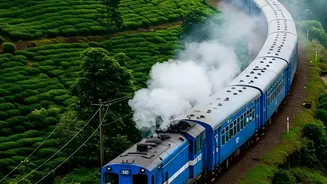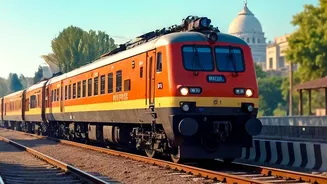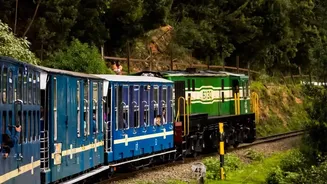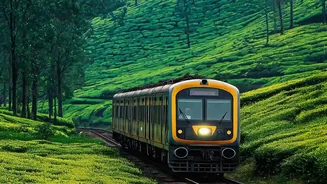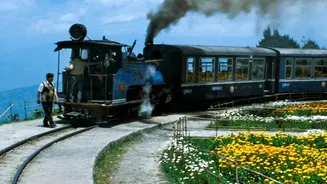




Puffing steam and whistling through misty mountains, the Darjeeling Himalayan Railway is more than a train; it's a journey back in time. This marvel of engineering, affectionately known as the 'Toy Train', is a living piece of history.
A Railway Born of Necessity
In the late 19th
century, Darjeeling was a burgeoning hub for the British, serving as a sanatorium and the heart of a lucrative tea industry. However, connecting this remote hill station to the plains was a gruelling task undertaken by pony and bullock cart along the winding Hill Cart Road. In 1878, Franklin Prestage of the Eastern Bengal Railway proposed an audacious solution: a steam-powered tramway that would follow the road's alignment. Construction began a year later, and by July 1881, the line to Darjeeling was complete, forever changing the region's fortunes by drastically cutting travel time and transport costs. The Darjeeling Steam Tramway Company was soon renamed the Darjeeling Himalayan Railway Company, and a legend was born.
The Ingenuity of Narrow-Gauge
The primary challenge was the steep, unforgiving terrain. To conquer it, engineers chose a track gauge of just two feet (610 mm). This 'narrow-gauge' design was a masterstroke of practicality. Unlike wider, standard-gauge tracks, narrow-gauge railways can be built with much sharper curves, allowing the track to hug the mountainside and navigate the tight contours of the land with minimal need for expensive and difficult tunnel construction. This decision is why the DHR could be built relatively quickly and cost-effectively, following the existing road for much of its 88-kilometre route from New Jalpaiguri to Darjeeling.
Engineering Loops and Reverses
Even with narrow-gauge tracks, some gradients were too steep for the early locomotives. This led to the implementation of ingenious engineering solutions that define the railway to this day: loops and zig-zag reverses. Instead of tunnelling through mountains, the railway ingeniously gains altitude by spiralling up and over itself in loops. The most famous of these is the Batasia Loop, completed in 1919, which offers panoramic views of Darjeeling and, on a clear day, the majestic Kanchenjunga. In other sections, the train employs 'reverses' or 'zig-zags', where it pulls forward onto a siding, then pushes back up the next section of track, effectively climbing the mountain in a Z-shaped pattern.
A Living World Heritage Site
In 1999, UNESCO declared the Darjeeling Himalayan Railway a World Heritage Site, recognising it as an 'outstanding example of a hill passenger railway'. It was lauded for its innovative transportation system that transformed the social and economic fabric of the region. The honor is a testament not just to its historical construction, but to its status as a fully operational railway that has retained most of its original features. The fleet includes vintage British-built 'B' Class steam locomotives, some over a century old, which still haul the popular tourist 'Joy Ride' services. These are supplemented by more modern diesel engines that handle the full-line service. The railway's workshops, particularly the one at Tindharia, continue to maintain these heritage machines.
The Toy Train Experience Today
For modern travellers, a ride on the Toy Train is a quintessential Darjeeling experience. While the full journey from New Jalpaiguri takes over seven hours, the most popular option is the 'Joy Ride'. This is a two-hour round trip from Darjeeling to Ghum, India's highest railway station at an altitude of 2,258 meters. The journey is slow, allowing passengers to soak in the stunning scenery of lush tea gardens, dense forests, and bustling hillside villages. The train makes a 10-minute stop at the picturesque Batasia Loop for photographs and a longer 25-minute halt at Ghum, where passengers can visit the DHR Museum included in their fare. It is this charmingly slow-paced, intimate journey through the Himalayas that continues to enchant visitors from around the world.