


Inside the Cosmic Cradle
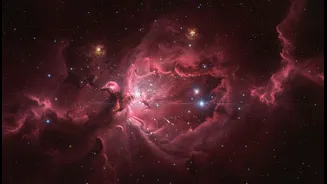
Stars are born inside vast, cold clouds of gas and dust known as molecular clouds. Often called stellar nurseries, these regions are like cosmic cradles where dense pockets of matter collapse under their own gravity to form baby stars, or protostars.
For ages, astronomers have been captivated by this process, but there has always been a fundamental problem: these nurseries are incredibly dusty and opaque. The very material that builds stars also acts like a thick fog, hiding the earliest, most crucial stages of star formation from view. Telescopes that see in visible light, like the Hubble Space Telescope in many cases, can only show us the glowing outer edges of these clouds, leaving the chaotic action within largely a mystery.
A Revolutionary New Picture
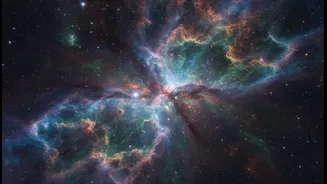
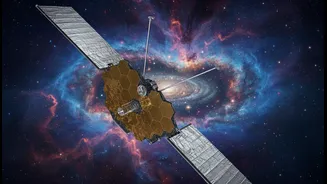
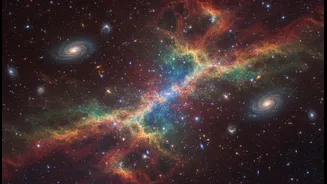
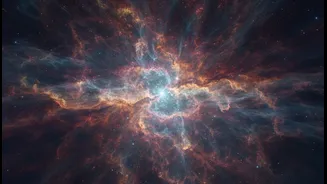
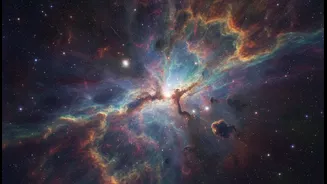
The latest view comes from the James Webb Space Telescope (JWST), whose powerful infrared vision can pierce through the obscuring dust. A recently released image of a star-forming region called FS Tau has provided a portrait of stellar birth in astounding detail. Where previous telescopes saw only murky clouds, Webb reveals intricate structures. The image showcases young protostars flickering to life, still wrapped in the disks of gas and dust from which they feed. One of the most striking features is the powerful outflows of material being ejected by a young star, carving out dramatic shapes in the surrounding gas and revealing the dynamic and often violent environment of a stellar nursery.
From Chaos to Order
The conventional wisdom held that star formation was a largely chaotic process, driven by turbulence inside giant molecular clouds. However, recent observations from Webb are refining this picture. In some regions, astronomers have been surprised to find a curious sense of order. For instance, observations of the Serpens Nebula revealed more than a dozen young stars ejecting material in the same direction. This alignment suggests that the stars all formed along the same powerful magnetic field lines, like beads on a cosmic string. This hints that magnetism may play a more significant and organising role in guiding how and where stars form than previously realised, imposing a degree of order on the cosmic chaos.
The Ripple Effect of Creation
The new images also provide a clearer look at a process known as feedback. The most massive and brilliant young stars unleash powerful stellar winds and intense ultraviolet radiation. This energy blows enormous bubbles in the surrounding gas, clearing out cavities in the molecular cloud. While this can shut down star formation in the immediate vicinity, it's not purely destructive. The shockwaves from this process can compress gas along the edges of these bubbles, triggering the collapse of new pockets of gas and sparking a fresh wave of star birth. In this way, the birth of one generation of stars can directly cause the next, creating a self-propagating cycle of creation across the galaxy.
Why We Study the Stars
Peering into these distant nurseries is about more than just satisfying our cosmic curiosity. The process of star formation is directly linked to our own origins. Every element in the universe heavier than hydrogen and helium was forged inside stars. When these stars die, often in spectacular supernova explosions, they scatter these enriched materials across space. This stardust becomes the raw material for the next generation of stars, as well as the planets, moons, and even the people that orbit them. By studying how stars begin, we are, in a very real sense, conducting galactic archaeology to uncover the story of how our own existence became possible.