



A Perfect Planetary Laboratory
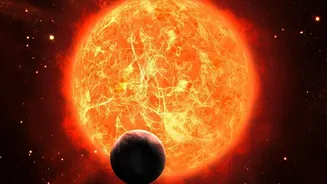
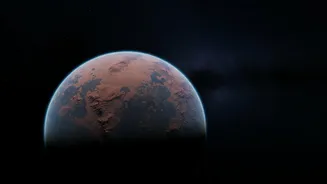
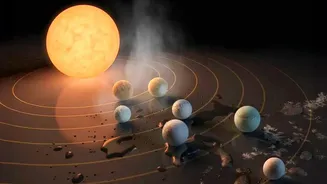
The TRAPPIST-1 system is an astronomer's dream. Its star is an ultra-cool red dwarf, much smaller and dimmer than our sun. All seven of its known planets are rocky, Earth-sized worlds huddled closely together, orbiting their star in a matter of days.
This compact arrangement is a huge advantage for scientists. Because the star is small, the planets block a larger fraction of its light when they pass in front of it, making their atmospheres easier to study. Furthermore, their short orbital periods mean scientists can observe these transits frequently, collecting data much faster than for planets in systems like our own. Several of these planets, including TRAPPIST-1e, f, and g, exist within the star's 'habitable zone'—the orbital region where temperatures could theoretically allow for liquid water, a key ingredient for life.
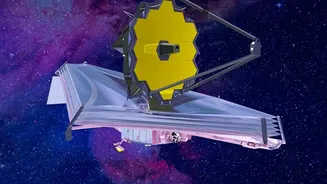
JWST: A Chemical Detective in Space
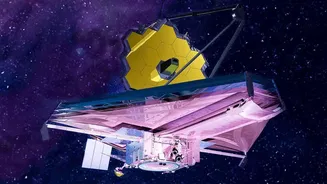
The James Webb Space Telescope (JWST) is humanity’s most powerful tool for peering into the atmospheres of these distant worlds. It doesn't take a direct picture of the planet's surface. Instead, it uses a technique called transmission spectroscopy. When a planet transits its star, a tiny amount of starlight filters through its atmosphere. Different gas molecules absorb specific wavelengths of light, leaving a unique chemical fingerprint in the light that reaches the telescope. JWST’s sensitive instruments can analyze this light, breaking it down into a spectrum and identifying which elements and molecules are present. This allows scientists to determine the composition of an exoplanet’s atmosphere, searching for gases like carbon dioxide, water vapor, and methane from trillions of kilometres away.
The Significance of Carbon
Finding carbon-based molecules is a critical first step in assessing habitability. Carbon is the backbone of all known life, so its presence is a prerequisite. So far, JWST's observations have yielded a complex picture. For instance, data suggests that the innermost planets, TRAPPIST-1b and 1c, likely lack any thick, substantial atmosphere. However, studies of other planets in the system, like TRAPPIST-1e, are ongoing, with initial observations ruling out thick hydrogen-based atmospheres but leaving the door open for secondary atmospheres made of heavier gases. Preliminary hints of methane have also been reported, though more research is needed to confirm if the signal comes from the planet or its star. The mere ability to detect or rule out carbon dioxide and hunt for methane is what elevates this system to a top priority.
More Than Just Building Blocks
The presence of carbon dioxide (CO2) can indicate a planet has a substantial atmosphere, which is necessary for stable surface temperatures and protection from harsh stellar radiation. But the real excitement often revolves around methane (CH4). On Earth, methane is overwhelmingly produced by living organisms and geological activity, like volcanoes. It's an unstable gas that is quickly broken down by starlight, so its continued presence implies some active process is constantly replenishing it. Discovering both methane and carbon dioxide in an atmosphere, especially with a low amount of carbon monoxide, could be a powerful biosignature. This is because many non-biological processes that create methane also produce carbon monoxide, while many life processes consume it. This chemical imbalance points toward a dynamic, and potentially living, world.
The Next Chapter in an Epic Search
The initial findings from JWST have transformed the TRAPPIST-1 planets from promising candidates into active subjects of intense study. Scientists now know that the innermost planets are likely barren rocks, which helps refine theories of planetary evolution around active red dwarf stars. For the outer planets in the habitable zone, the search is just beginning. Each observation helps scientists narrow down the possibilities. Ruling out a thick CO2-dominated atmosphere on TRAPPIST-1e, for example, means it isn't a Venus-like hothouse. Future observations will aim to confirm or deny the presence of a thinner atmosphere and search for other vital molecules like water and oxygen. These detections are painstakingly difficult, requiring dozens of transit observations to build a clear signal, but the potential payoff is a new understanding of our place in the cosmos.