






The Power of a 10-Minute Habit
Modern work often keeps professionals tied to a desk for eight or more hours, leading to a sedentary lifestyle that can increase health risks and cause issues like back pain and poor posture. The good news is that you don't need to block out an hour to make
a difference. Research shows that short, consistent bursts of activity, sometimes called 'exercise snacks', can deliver significant benefits. Just 10 minutes of daily movement can boost your mood, improve focus, increase productivity, and begin to counteract the negative effects of prolonged sitting. The key isn't intensity, but consistency. By making a small, manageable commitment, you're more likely to stick with it long enough for it to become an automatic part of your day, just like brushing your teeth.
Build Your Habit with Stacking
The biggest hurdle isn't the exercise itself; it's making it a habit. A powerful technique for this is 'habit stacking', a concept popularized by author James Clear. The method involves linking a new habit (your 10-minute workout) to an existing, automatic one. The formula is simple: 'After I [current habit], I will [new habit]'. For a busy desk worker, this could look like: 'After I turn off my morning alarm, I will do my 10-minute workout'. Or, 'Right after I close my laptop for the day, I will change into my workout clothes and exercise'. This strategy removes the need for motivation and decision-making. By piggybacking on a behaviour that's already wired into your brain, you create a powerful cue that makes the new routine feel effortless over time.
A Blueprint for Your 10-Minute Workout
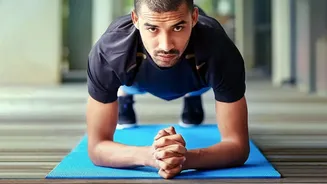
A great 10-minute routine for desk workers should focus on mobility to undo stiffness, and strength to activate muscles weakened by sitting, like the glutes and core. You don't need any special equipment. Aim to perform each exercise for about 45 seconds with 15 seconds of rest in between. Here is a sample full-body circuit: Bodyweight Squats: To activate glutes and legs. Push-ups: Can be done on your knees or against a wall to build upper body strength. Plank: To engage your entire core. Glute Bridges: Lie on your back and lift your hips to counteract weak glute muscles from sitting. Jumping Jacks or High Knees: To get your heart rate up and boost circulation. Seated Spinal Twists: A great way to increase mobility in your back right from your chair.
Exercises to Counteract Sitting
Prolonged sitting tightens hip flexors and weakens crucial posture muscles. Specific stretches and movements can target this. Incorporate these into your routine or do them during short breaks. Hip Flexor Stretch: Kneel on one knee (use a cushion) with the other foot forward, and gently push your hips forward until you feel a stretch in the front of your hip. Hold for 30 seconds on each side. Cat-Cow Stretch: On all fours or even seated in your chair, alternate between arching your back (cow) and rounding your spine (cat). This helps relieve stiffness in the spine. Wall Sit: Stand with your back against a wall, then slide down until your knees are at a 90-degree angle, as if sitting in a chair. Hold for 30-60 seconds to build leg and core strength. Leg Swings: Holding onto a wall or desk for balance, swing one leg forward and backward, then side to side, to improve hip mobility.
Making It Stick for the Long Haul
The first few weeks are crucial for habit formation. To ensure your new routine lasts, set yourself up for success. Prepare your environment by laying out your workout clothes the night before or designating a small, clear space in your home for exercise. Use reminders on your phone for your scheduled time. It's also important to be realistic; don't get discouraged if you miss a day. The goal is progress, not perfection. Track your sessions in a journal or app to see how far you've come, and celebrate the small wins. Pay attention to how you feel—more energy, better focus, less stiffness. These immediate rewards are powerful motivators that will keep you going far more than any long-term goal.