



A New Counterpart to the Famous Hexagon
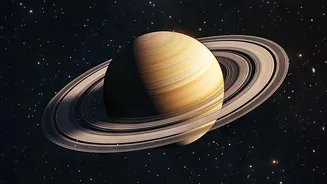
For over 40 years, scientists have been fascinated by Saturn's North Pole Hexagon, a stable, six-sided jet stream wider than planet Earth. It was considered a unique oddity in the solar system. However, recent observations have revealed it is not alone.
In a major discovery announced in early September 2026, astronomers confirmed the existence of a giant, 10-sided atmospheric wave, or decagon, at Saturn's south pole. This finding, published in the journal Science Advances, shows that Saturn can form strange, polygonal weather patterns in both of its hemispheres, changing our understanding of the planet's atmospheric dynamics.
It's a Brand-New and Evolving Feature
One of the most exciting aspects of this discovery is how new it is. The Cassini spacecraft, which orbited Saturn from 2004 to 2017, never detected any signs of a persistent decagon. Scientists began seeing faint hints of the structure emerging in images from 2023, and it has become much more distinct and stronger in subsequent observations. Unlike the northern hexagon, which has been a fixture for decades, this southern decagon appears to be actively developing right before our eyes. This gives researchers a rare and valuable opportunity to watch a giant atmospheric pattern take shape in real time on another world.
A Deep, Towering Atmospheric Wave
This isn't just a pattern painted on the cloud tops. The decagon is a powerful atmospheric wave embedded within one of Saturn's high-speed jet streams. Observations from the Hubble Space Telescope at different wavelengths of light show that the structure extends deep into the planet's atmosphere, making it a vertically significant feature, not a shallow one. Probing these different atmospheric layers causes the decagon's exact position to appear to shift slightly, confirming it is a complex, three-dimensional structure. Its sheer scale and depth make it a truly monumental piece of planetary weather.
Hubble's Long Watch Made It Possible
This discovery wouldn't have been possible without the consistent, long-term monitoring of the Hubble Space Telescope. The images were captured as part of the Outer Planet Atmospheres Legacy (OPAL) program. This project involves Hubble taking yearly snapshots of our solar system's gas giants—Jupiter, Saturn, Uranus, and Neptune—to track how their atmospheres change over time. While ground-based observers first noticed an unusual band in 2024, it was Hubble's sharp, high-resolution view from space that provided the clear, unambiguous data needed to confirm the feature's 10-sided shape and track its evolution back to 2023.
Many Questions Remain Unanswered
While the discovery is thrilling, it opens up a host of new questions for planetary scientists. Why did the decagon form so suddenly, when nothing like it had been seen there before? Will it stabilize and persist for decades like the northern hexagon, or is it a more transient phenomenon? Scientists are still working to understand the underlying atmospheric conditions that can produce these enormous geometric shapes. Answering these questions will require further observations from Hubble and likely the James Webb Space Telescope, which can study Saturn in different wavelengths of light to reveal more about its temperature, composition, and atmospheric flows.