




A Cosmic Meeting in the Twilight
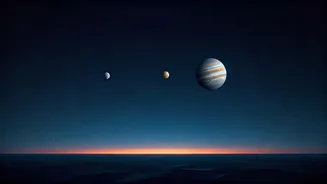
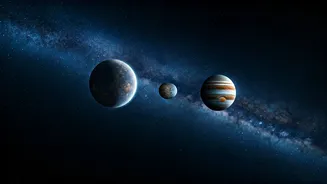
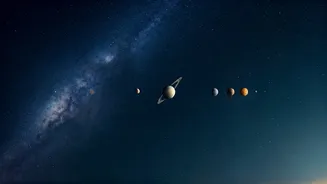
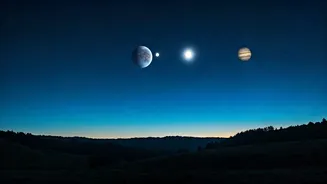
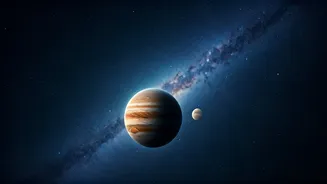
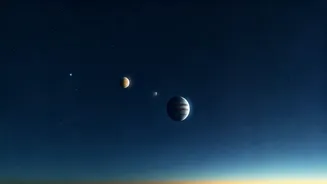
If you’ve been gazing at the evening sky recently, you’re not imagining things: it has been particularly dazzling. A planetary conjunction, featuring the bright jewels of our solar system, is putting on a show. Venus, Jupiter, and the more elusive Mercury
are lining up in the same patch of sky, creating a stunning visual spectacle visible to the naked eye. This isn't a collision or a physical meeting, but a beautiful trick of perspective. From our vantage point on Earth, the orbital paths of these planets cause them to temporarily appear clustered together, offering a rare and memorable sight for sky-gazers across India.
What Exactly Is a Planetary Conjunction?
In simple terms, a conjunction is an astronomical event where two or more celestial objects appear close to one another in the sky. Think of it like watching cars on a multi-lane, circular racetrack from the grandstand. At times, from your specific viewpoint, two or three cars might look like they are side-by-side, even though they are in different lanes and moving at different speeds. The planets in our solar system are doing the same thing. They all orbit the Sun, but on different paths and at different paces. A conjunction occurs when Earth, and two or more other planets, fall into a line of sight. They may be hundreds of millions of kilometres apart in reality, but from our terrestrial home, they look like cosmic neighbours having a brief chat.
The Stars of the Show
To truly appreciate the event, it helps to know who you’re looking for. The trio consists of three very different worlds. **Venus:** You can’t miss it. Venus is the brightest object in the sky after the Sun and Moon. Often called the “Evening Star” or “Morning Star,” its thick, reflective cloud cover makes it shine with a brilliant, steady white light. In this conjunction, it will likely be the most dominant point of light. **Jupiter:** The king of planets is also a showstopper. While not as intensely bright as Venus, Jupiter is still one of the brightest objects in the night sky. It shines with a strong, unwavering light, unlike stars which tend to twinkle. Binoculars might even reveal its four largest moons—Io, Europa, Ganymede, and Callisto—as tiny pinpricks of light flanking the planet. **Mercury:** This is the real prize for dedicated observers. As the closest planet to the Sun, Mercury is notoriously difficult to spot. It never strays far from the Sun’s glare and is only visible for short periods during twilight. It will appear as a much fainter point of light, likely very low on the horizon. Spotting it requires a clear view and good timing.
Your Guide to Spotting the Planets
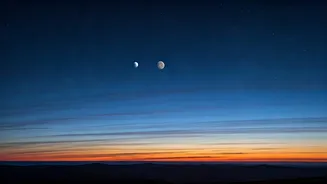
The best part about this cosmic display is that you don’t need any fancy equipment. Here’s how to see it: **Timing is Everything:** The ideal viewing window is about 30 to 75 minutes after sunset. This is when the sky is dark enough for the planets to become visible, but before they sink below the western horizon. **Look West:** As the Sun sets in the west, that’s the direction you need to face. The planets will be gathered in the band of colourful twilight sky. **Find a Clear Horizon:** For the best view, especially for spotting low-lying Mercury, find a location with an unobstructed view of the western horizon. Rooftops, open fields, or a spot overlooking a lake or the sea are perfect. Try to get away from the light pollution of city centres if you can. **What to Bring:** Just your eyes are enough! However, a pair of binoculars can enhance the experience, making the planets appear as small discs rather than points of light and potentially revealing Jupiter’s moons.
More Than Just a Pretty Sight
Planetary conjunctions have fascinated humanity for millennia. Before telescopes and modern science, these celestial gatherings were seen as powerful omens and played a crucial role in the development of astronomy and astrology. Today, they serve a different but equally important purpose. They are a magnificent, real-time demonstration of the mechanics of our solar system—a visual reminder of the vast, clockwork-like dance of the planets. They encourage us to step outside, look up, and connect with the cosmos. It’s a shared experience, a moment of wonder available to anyone willing to simply pause and observe.