



A One-in-a-Million Discovery
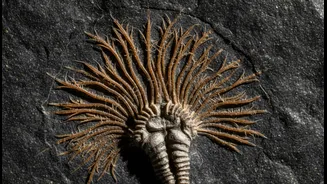
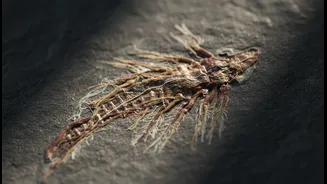
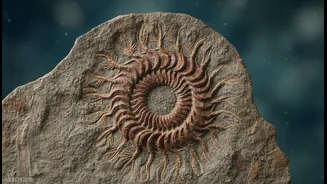
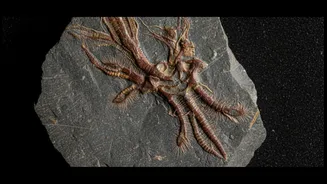
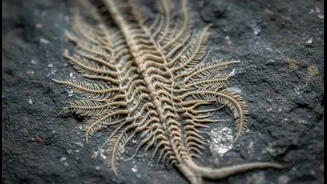
Researchers in Oklahoma have unveiled an astonishingly well-preserved fossil of an ancient marine animal called a crinoid. Known as Dendrocrinus simcoensis, this creature lived long before the dinosaurs, in a shallow sea covering what is now North America.
Crinoids, often called 'sea lilies,' are relatives of modern starfish and sea urchins, using feathery arms to filter food from the water. While their bony plates are common fossils, the soft parts almost never survive. This new find is only the second time in history that a crinoid's soft tissues have been found preserved, revealing its delicate 'tube feet'—appendages used for feeding and movement. For soft tissue to fossilize, conditions must be perfect: rapid burial, no oxygen, and the right chemical balance to halt decay almost instantly. This makes the discovery a snapshot of a creature's biology from a time so distant it is almost unimaginable, giving us a look at features that are typically lost forever.
Seeing Through Solid Rock
This clearer view of ancient life isn't just about getting lucky. It’s also about technology. For decades, paleontologists were limited by what they could see on the surface of a fossil. Trying to chip away the surrounding rock to reveal delicate structures was often a destructive, high-risk process. Today, scientists use non-invasive tools like high-resolution computed tomography (CT) scanners to peer inside stone without ever touching a chisel. This technology, similar to what's used in hospitals, takes thousands of X-ray images and compiles them into a detailed 3D model. Researchers can digitally navigate through the fossil, separating bone from rock and even identifying the faint traces of fossilized nerves, brains, and organs. This allows them to reconstruct the internal anatomy of animals that have been extinct for half a billion years, turning a silent stone into a biological blueprint.
The Ghosts in the Fossils
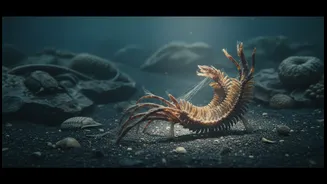
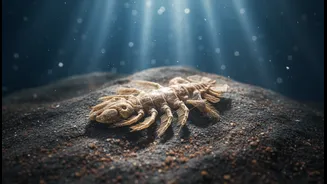
The crinoid discovery is part of a wave of recent finds revealing the soft anatomy of early animals. In fossil beds in China and Canada, scientists have uncovered the ancestors of today's insects and spiders with their central nervous systems still visible. One 525-million-year-old worm-like animal, Cardiodictyon, was found with its brain so perfectly preserved that it challenged a century-old theory about how animal heads evolve. It showed that the brain and the segmented body likely evolved separately, a radical idea. Similarly, the brain of another ancient arthropod, Alalcomenaeus, was found to be remarkably similar to that of modern scorpions and horseshoe crabs, providing a direct link between a bizarre Cambrian creature and its living relatives. These are not just curiosities; the layout of a nervous system is a fundamental roadmap to an animal's life and its place in the evolutionary tree.
Rewriting the Animal Family Tree
Each of these discoveries acts like a long-lost birth certificate, helping scientists reconstruct the sprawling family tree of animal life. For years, the era following the 'Cambrian Explosion'—a burst of evolution that produced the first major animal groups—was a bit of a mystery. But exceptional fossil sites like the Fezouata Biota in Morocco, which is around 478 million years old, are filling in the gaps. They show that many 'Cambrian weird wonders,' once thought to be evolutionary dead ends, actually survived for millions of years longer than presumed, living alongside the ancestors of more modern groups. This suggests the so-called explosion of life was more of a long, simmering fuse. By revealing the internal anatomy and hidden relationships of these creatures, scientists can more accurately determine who is related to whom, redrawing connections between entire phyla and clarifying the very origins of the creatures that populate our world today.