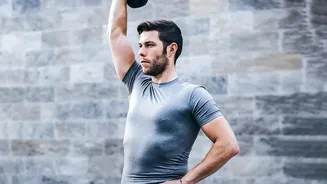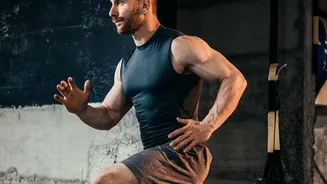



When it comes to building stronger thighs, you don't need a gym full of complex machines. Two of the most powerful tools are already with you: squats and lunges. This is how these bodyweight basics build strength and a lasting fitness practice.
The Science of Simple Strength
Bodyweight
training is effective because it uses resistance to challenge your muscles, forcing them to adapt and grow stronger. Squats and lunges are compound exercises, meaning they work multiple muscle groups and joints at once. This makes them incredibly efficient. They primarily target the large muscles of your lower body, including the quadriceps (front of the thigh), hamstrings (back of the thigh), and glutes (buttocks). But they also engage your core for stability and improve your overall balance and coordination. Because these movements mimic everyday actions like sitting, standing up, and climbing stairs, strengthening them improves your functional fitness, making daily life easier and reducing injury risk.
Squats: The Foundational Movement
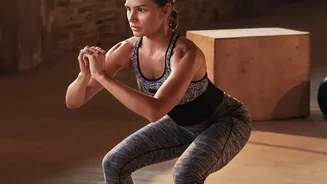
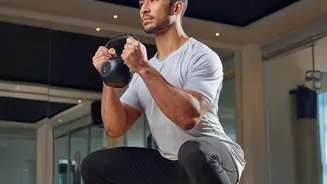
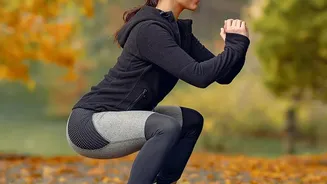
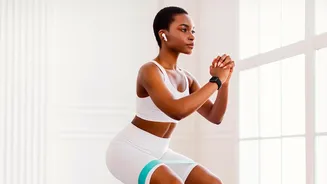
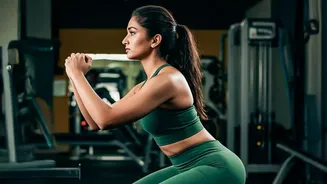
The squat is often called the king of exercises for a reason. It is a fundamental human movement that powerfully trains your quadriceps, glutes, and even hamstrings. A proper bodyweight squat involves hinging at your hips and bending your knees as if you’re sitting down in a chair, keeping your chest up and back straight. The key is to lower your body until your thighs are at least parallel to the floor, which ensures full muscle engagement. This simple action, when done correctly and consistently, builds the raw strength that powers everything from jumping higher to simply getting up from a low sofa with ease.
Mastering the Perfect Squat
Proper form is crucial to get the benefits and avoid injury. Start by standing with your feet about shoulder-width apart, with your toes pointing slightly outward. Engage your core muscles to keep your spine neutral. Begin the movement by pushing your hips back first, then bending your knees. Keep your chest lifted and your eyes looking forward. Lower down as far as you comfortably can, aiming for thighs parallel to the ground, while keeping your heels planted firmly on the floor. Your knees should track in line with your toes and not cave inward. To stand back up, push through your heels, rising with a controlled motion until you are back in the starting position.
Lunges: For Stability and Unilateral Strength
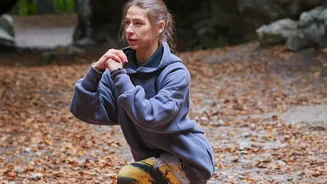
While squats are bilateral (working both legs at once), lunges are a unilateral exercise, focusing on one leg at a time. This is their unique advantage. Lunges challenge your balance significantly more than squats, forcing the smaller stabilizing muscles in your hips and core, like the gluteus medius, to work harder. This helps identify and correct muscle imbalances between your left and right sides. Studies have shown that while both exercises work similar muscles, lunges tend to increase activity in the hamstrings and gluteus medius, making them an excellent complement to squats for well-rounded leg development.
Executing the Ideal Lunge
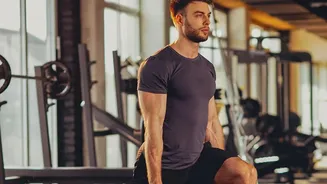
To perform a forward lunge, start standing with your feet hip_width apart. Take a big step forward with one leg, keeping your torso upright. Lower your hips until both knees are bent at approximately a 90_degree angle. Your front knee should be directly above your ankle, not pushed out over your toes, and your back knee should hover just above the floor. Push off your front foot to return to the starting position. A common mistake is taking too narrow a stance, as if walking on a tightrope, which compromises balance. Keeping your feet hip_width apart throughout the movement provides a more stable base.
Building a Consistent Practice
The 'practice' part of training is about consistency and progression. Your muscles only grow stronger if you continually challenge them—a principle known as progressive overload. With bodyweight exercises, you can't just add more plates to a barbell. Instead, you can increase the challenge by adding more repetitions or sets, slowing down the movement (increasing time under tension), reducing rest time between sets, or moving to more difficult variations like pistol squats or jump lunges. Start with a manageable number of reps where your form is perfect, such as 3 sets of 10–12 reps for each exercise. As that becomes easier, gradually increase the reps or explore a more challenging variation to keep making progress.