








A Cosmic Ghost Story
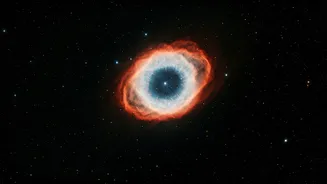
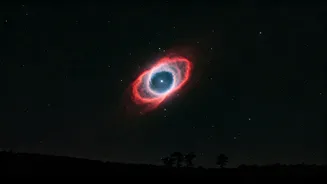
Before you hunt for it, it helps to know what you’re looking for. The Ring Nebula, officially known as Messier 57 (M57), isn’t a star but the glowing remains of one. Located about 2,300 light-years away, it’s what astronomers call a planetary nebula.
This beautiful, colourful ring is the outer layer of a sun-like star that puffed away into space as it reached the end of its life. At its centre lies a tiny, incredibly dense white dwarf—the hot, collapsed core of the original star. Seeing it through a telescope is like looking back in time and witnessing the beautiful, ghostly aftermath of a star’s death. Its distinct doughnut shape makes it one of the most famous and rewarding targets for amateur astronomers.
Why This Is the Perfect Season
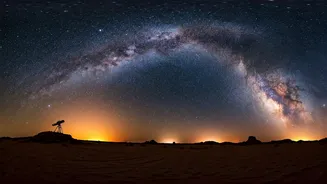
Timing is everything in stargazing. The Ring Nebula is located in the small but distinct constellation of Lyra, the Harp. During the summer and monsoon months in India, Lyra rides high in the sky after sunset, reaching its highest point around midnight. This prime position means the nebula is far above the atmospheric haze that often hugs the horizon, giving you the clearest possible view. Weekend nights, especially those away from the bright lights of the city, offer the perfect opportunity. The later you stay up, the higher and clearer Lyra will appear, making a midnight expedition well worth the effort.
Your Step-by-Step Viewing Guide
Finding a faint nebula can feel daunting, but M57 is surprisingly easy to locate if you know where to look. First, find Vega, the brightest star in Lyra and one of the brightest stars in the entire night sky. You can’t miss it; it will be a brilliant blue-white jewel almost directly overhead around midnight. Lyra itself is a small parallelogram of four fainter stars attached to Vega. The Ring Nebula lies about halfway between the two bottom stars of this parallelogram, Sulafat and Sheliak. You won't see the ring with your naked eye, but this is precisely where you should point your telescope. Start with a low-power eyepiece to find the general area, then switch to a higher magnification to resolve the faint, smoky ring.
The Right Gear for the Job
Let’s be clear: spotting the Ring Nebula requires more than just your eyes. While powerful binoculars might reveal a faint, fuzzy patch of light, a telescope is essential to see its iconic ring shape. A small telescope with at least a 4-inch (100mm) aperture will show it as a tiny, ghostly circle. A larger 8-inch (200mm) telescope, the kind often found at astronomy club events, will provide a much more detailed and impressive view, revealing hints of its structure and the faint central star. The key is to get to a dark location. Even the best telescope will struggle against city light pollution, so heading out of town will dramatically improve your chances of a spectacular view.
Joining a Skywatching Camp
The headline mentions camps, and for good reason. Joining an organized event is the best way for beginners to experience the cosmos. Most major Indian cities have active amateur astronomy clubs (like those in Mumbai, Delhi, Pune, and Bengaluru) that regularly host weekend skywatching sessions or “star parties” at dark-sky locations just outside the city limits. These events are perfect because they offer access to powerful telescopes and knowledgeable guides who can point them directly at the Ring Nebula and other celestial wonders. A quick online search for “astronomy club near me” or “stargazing events in [your state]” will yield many options. Astrotourism companies also offer more immersive weekend camps in places like Ladakh, Spiti, Kutch, or near wildlife sanctuaries—all famed for their pristine night skies.