




A World With a Hidden Ocean
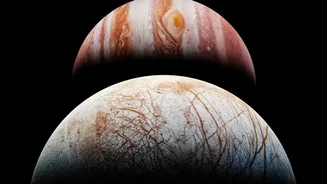
For decades, scientists have been captivated by Europa. Slightly smaller than Earth's moon, it is one of the most compelling places in our solar system to search for life beyond our own planet. Evidence gathered by previous missions, particularly NASA's
Galileo spacecraft in the 1990s, strongly suggests that a global ocean of saltwater is hidden beneath its frozen surface. This isn't a small sea; it's estimated that Europa’s ocean could contain more than twice as much water as all of Earth's oceans combined. The presence of liquid water is a critical ingredient for life as we know it, making Europa a top-tier destination for astrobiological research. Its smooth, fractured surface, streaked with reddish-brown material, hints at a dynamic world where the ocean below may be interacting with the ice shell, possibly delivering chemicals and energy—two other key components for habitability.
The Long Voyage of the Clipper
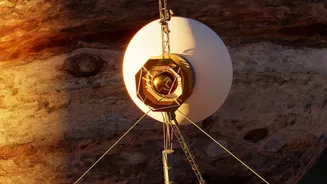
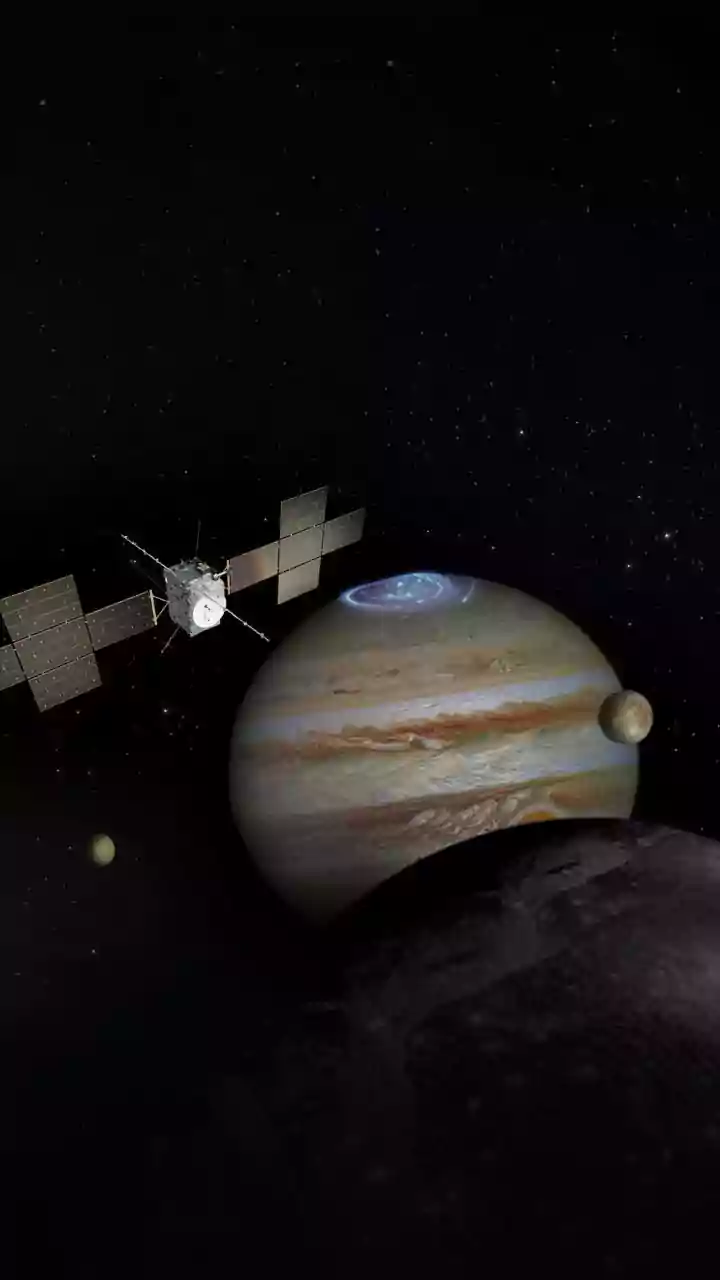
The headline suggests the probe is already there, but the journey to Jupiter is a marathon, not a sprint. The Europa Clipper spacecraft, the largest interplanetary probe ever built by NASA, launched in October 2024. As of September 2026, it is well into its 2.9-billion-kilometre voyage. To build up the immense speed needed to reach the outer solar system, the Clipper is performing a series of planetary flybys. It completed a gravity-assist manoeuvre with Mars in early 2025 and is on track for its final boost from Earth in December 2026. This complex trajectory will slingshot the spacecraft toward Jupiter, with arrival scheduled for April 2030. Instead of orbiting the radiation-heavy Europa directly, the Clipper will enter a long, looping orbit around Jupiter itself, performing nearly 50 close, rapid flybys of its target moon. This strategy protects its sensitive electronics while allowing for detailed study over several years.
A Toolkit for Cosmic Discovery
To investigate a world it cannot land on, the Europa Clipper is equipped with a powerful suite of nine complementary science instruments—the “planetary sensors” designed to probe the moon from afar. Chief among them is an ice-penetrating radar called REASON. This instrument will act like a geological sonar, sending radio waves through the ice shell to measure its thickness and search for the definitive signature of the ocean below. It might even be able to spot pockets of trapped water within the ice. Meanwhile, a sophisticated magnetometer will measure the distortion of Jupiter’s magnetic field as it passes through Europa. Because a salty ocean is electrically conductive, it will create its own weak magnetic field, and measuring this effect will allow scientists to confirm the ocean's existence and even estimate its depth and salinity. Other instruments, including a thermal imager, will scan the surface for warm spots that could indicate recent eruptions of warmer water from below.
Sniffing for the Ingredients of Life
While finding life itself is beyond the scope of this mission, the Clipper is expertly designed to determine if Europa is habitable. To do this, it needs to understand the moon's chemistry. Several spectrometers will analyze the light reflecting off Europa's surface to identify the composition of its ice, salts, and any potential organic compounds. These instruments will create detailed chemical maps of the moon. In a more direct approach, the spacecraft will also “taste” the environment. A dust analyzer will examine tiny particles ejected from the surface by micrometeoroid impacts, giving scientists a direct sample of Europa's surface material. Even more exciting is the prospect of flying through a plume of water vapor venting into space from the ocean below. A mass spectrometer is on board to sniff the gases in any such plume, which would offer an unprecedented look at the chemical makeup of the hidden ocean without ever having to touch it.