




The Dawn of Reusability
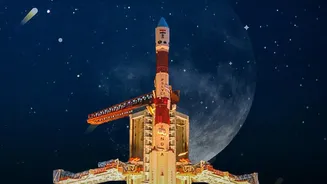
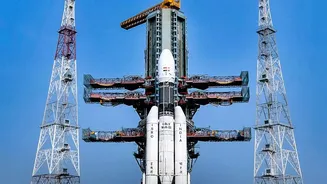
One of the most significant shifts in ISRO's strategy is the aggressive development of reusable launch vehicles (RLVs). While rockets like the PSLV and GSLV are workhorses, they are expendable. The future lies in reusability to make space access cheaper
and more frequent. ISRO's answer is the Pushpak Reusable Launch Vehicle, a winged technology demonstrator designed to land autonomously on a runway, much like an aircraft. Through a series of successful landing experiments (RLV-LEX), ISRO has been perfecting the critical technology for horizontal landing. These tests involve releasing the vehicle from a helicopter at high altitude and letting it guide itself to a precise landing. This is a stepping stone towards a Two-Stage-to-Orbit (TSTO) vehicle, where the first stage would fly back and land, ready for its next mission. The agency is also exploring Vertical Take-off and Vertical Landing (VTVL) technology, similar to what SpaceX uses for its boosters.
AI and Robotics in Orbit
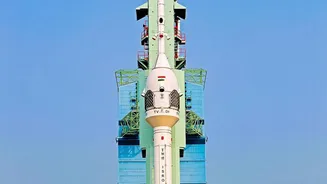
Artificial Intelligence (AI) is becoming central to ISRO's future missions, moving beyond simple automation to intelligent decision-making in space. AI algorithms were instrumental in the Chandrayaan missions, helping the lander and rover navigate the lunar surface. This integration of AI is set to deepen with the Gaganyaan human spaceflight programme. ISRO is developing Vyommitra, a half-humanoid robot, which will fly on uncrewed test missions to validate the crew module's life support systems and performance before astronauts fly. Beyond human spaceflight, AI is being developed for a range of applications, including satellite health monitoring, processing vast amounts of Earth observation data for weather forecasting and resource mapping, and enabling space robotics for complex in-orbit tasks. The goal is to create more autonomous spacecraft that can react to unforeseen circumstances without direct commands from Earth.
A Quantum Leap for Secure Communication
In an era of digital espionage, securing communications is paramount. ISRO is pioneering quantum communication, a technology considered 'future-proof' against hacking. Unlike conventional encryption, which relies on mathematical complexity, quantum communication is secured by the laws of physics. ISRO has already successfully demonstrated Quantum Key Distribution (QKD) over a free-space link of 300 meters, using it for secure text, image, and video transmission. This is a crucial first step towards creating a satellite-based quantum communication (SBQC) network. Such a network would provide ultra-secure communication channels for strategic sectors like defence and banking, and form the backbone of a new, un-hackable internet. ISRO's advancements in this area position India among a handful of nations mastering this complex technology.
Building an Address in Space
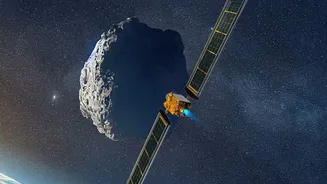
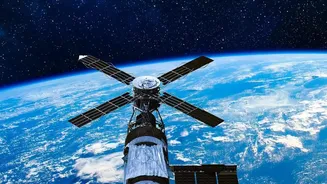
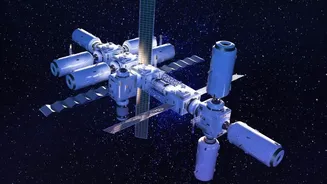
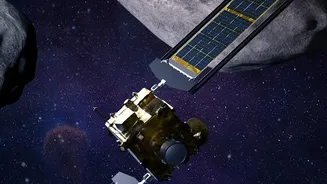
ISRO's ambitions extend to establishing a sustained human presence in orbit. The agency is laying the groundwork for the Bharatiya Antariksh Station (BAS), India's own space station, with a target for it to be operational by 2035. The first module is planned for launch by 2028. This orbital outpost will serve as a laboratory for long-duration microgravity research and a hub for advanced space operations. To build and service such a station, ISRO is developing crucial docking technologies. The upcoming SPADEX missions are designed to perfect the ability for two spacecraft to meet and dock in orbit, a prerequisite for transferring crew, cargo, and fuel. This capability is not just for the space station but also for future complex missions, including the Chandrayaan-4 sample return mission.