


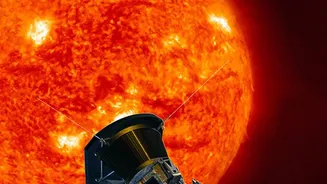
In a landmark achievement for space science, India's Aditya-L1 and the European Space Agency's Proba-3 missions have teamed up. This powerful collaboration is providing a deeper understanding of the Sun's violent and mysterious eruptions.
India’s Vigilant Eye on the Sun
Launched in September
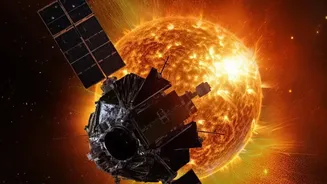
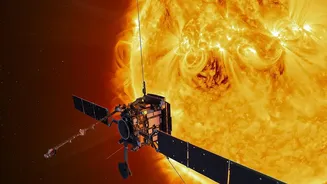
2023, Aditya-L1 is India's first dedicated mission to study the Sun. Positioned at the first Lagrange point (L1) nearly 1.5 million kilometres from Earth, it enjoys an uninterrupted view of our star, free from eclipses or occultations. Its primary instrument for this collaborative work is the Visible Emission Line Coronagraph (VELC). A coronagraph is designed to block the overwhelming glare from the Sun's bright disk, allowing scientists to see the much fainter outer atmosphere, or corona. The VELC, developed by the Indian Institute of Astrophysics (IIA), is a sophisticated tool that uses spectroscopy to analyse the properties of the coronal gas, such as its temperature and density.
ESA's Artificial Eclipse in Space
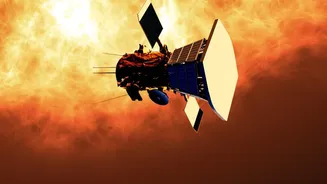
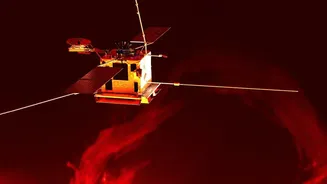
The European Space Agency's Proba-3 mission, which was notably launched by an ISRO PSLV rocket in late 2024, is an engineering marvel. It is the world's first precision formation-flying mission, consisting of two separate satellites. One spacecraft acts as an 'Occulter', flying about 150 metres in front of the second 'Coronagraph' satellite. Together, they create a near-perfect artificial solar eclipse that can last for hours at a time. This precision manoeuvre allows its main instrument, ASPIICS, to capture incredibly sharp images of the Sun's inner corona, a region notoriously difficult to observe.
A Tandem for Unlocking Solar Secrets
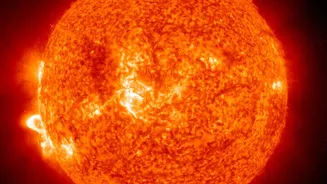
The collaboration's genius lies in combining the strengths of these two unique instruments. While Aditya-L1's VELC provides spectroscopic data (analysing light properties), Proba-3's ASPIICS captures crisp images. When studying the same event, like a Coronal Mass Ejection (CME), ASPIICS provides sharp images to map the eruption's shape and movement, while VELC's spectroscopic data gives independent measurements of the plasma's density and temperature. This dual approach allows scientists to cross-check their findings, leading to more accurate and reliable estimates of a CME's mass and energy. The first joint analysis of two CMEs in September 2025 has already demonstrated the power of this synergy.
Why Measuring Solar Storms Matters
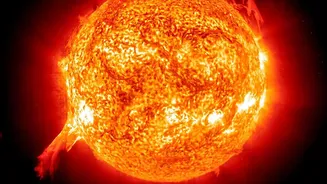
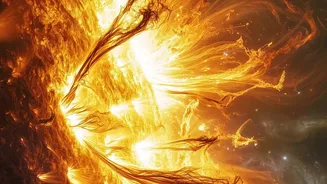
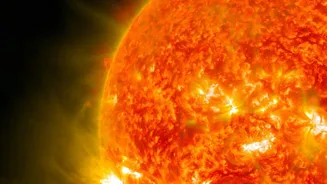
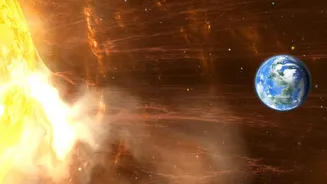
Coronal Mass Ejections are massive explosions of plasma and magnetic fields from the Sun. When these eruptions are aimed at Earth, they can cause significant disruptions, a phenomenon known as space weather. These solar storms can damage critical satellites used for communication and navigation, pose radiation risks to astronauts, and even trigger large-scale power grid failures on the ground. Observing CMEs right as they form in the inner corona is crucial for understanding how they accelerate and evolve. Until now, observing this early stage has been challenging. This new joint capability provides the vital data needed to improve our models and forecasts for space weather, ultimately helping to protect our increasingly technology-dependent society.
A Partnership Defining the Future
The joint analysis by scientists at the Indian Institute of Astrophysics and their European counterparts represents more than just a scientific breakthrough; it's a testament to the power of international collaboration. By combining data from two of the world's most advanced solar missions, the scientific community can now tackle longstanding questions about the Sun that neither mission could fully answer alone. This partnership between ISRO and ESA not only enhances the scientific return of Aditya L1 but also cements India's position as a key player in global space exploration. The ability to pair an imaging coronagraph with a spectroscopic one yields a far more complete view of solar eruptions, paving the way for future discoveries about our star.