





The Universe’s Flickering Beacons
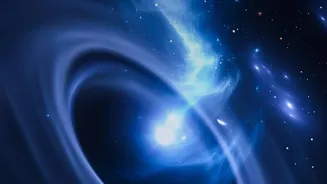
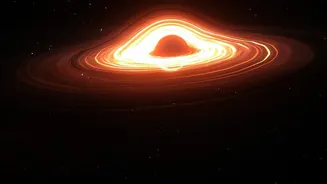
Imagine a lighthouse beacon so powerful it can be seen across billions of light-years. That’s a quasar. A quasar is not the black hole itself, but the intensely bright light show produced by an 'accretion disk' — a vast, swirling pancake of gas, dust,
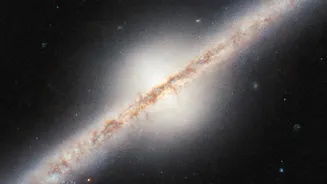
and stars heating up as it spirals into a supermassive black hole. For over a decade, scientists have observed that these quasars don’t shine with a steady light. Instead, their brightness varies unpredictably, sometimes doubling or halving over a period of years. This slow, random fluctuation has been one of the most persistent puzzles in modern astrophysics. It wasn’t a simple twinkle; it was a deep, chaotic 'breathing' from the edge of oblivion, and no one could definitively explain what was causing it.
Searching for a Cosmic Culprit
Solving this mystery was a monumental task. These objects are so distant that we can't see the details directly. Scientists had to act like cosmic detectives, piecing together clues from the light that reaches our telescopes. Several theories were proposed over the years. Could the flickering be caused by giant stars exploding (supernovae) in the galaxy around the black hole? Or perhaps the gravity of foreground stars was bending and magnifying the quasar's light, an effect known as microlensing. While these events do happen, they couldn't account for the specific, random-walk pattern seen in the data. The fluctuations were too persistent and chaotic. Another leading idea was that the accretion disk itself was somehow unstable, but the physical mechanism remained elusive, leaving the core question unanswered.
A 'Mosh Pit' of Stars
The breakthrough came from a new perspective: what if the accretion disk wasn't just a smooth river of gas? A team of astrophysicists proposed that these disks are far more chaotic environments, seeded with tens of thousands of stars. They described the scene as a stellar 'mosh pit' or a cosmic pinball machine. In this model, thousands of stars are caught in orbit within the gaseous disk, moving chaotically. They aren't just passively floating along; they are constantly crashing through the dense gas, creating shockwaves and bright flares, much like a meteor burning up in Earth's atmosphere. Each individual collision would be a tiny flash, but the combined, random effect of thousands of them could be the source of the large-scale flickering.
The Breakthrough Simulation
To test this 'stellar mosh pit' theory, scientists turned to powerful computer simulations. They built a virtual accretion disk and populated it with up to 100,000 digital stars, each with its own random orbit. Then, they let the simulation run, programming the physics of how these stars would interact with the surrounding gas. The results were stunning. The simulation produced light fluctuations that perfectly mimicked the random, decade-long flickering observed in real quasars. It showed how countless small, independent events — the stellar collisions — could add up to create the massive, slow changes in brightness. It was the scientific equivalent of realizing that the roar of a crowd is just the sum of thousands of individual voices.
From Code to the Cosmos
A simulation is only as good as its ability to predict reality. The final step was to compare the light patterns generated by the computer model against years of actual observational data collected from telescopes surveying the night sky. The match was remarkable. The model successfully reproduced the 'random walk' in brightness that had stumped astronomers for so long. The 'how' was finally clear: the decade-long fluctuations were not from one single, giant process, but the cumulative effect of thousands of stars constantly stirring up the cosmic soup of the accretion disk. The discovery provides the first robust, physical model that explains this fundamental property of the universe’s most massive and powerful engines.