






From Government Icon to Commercial Platform
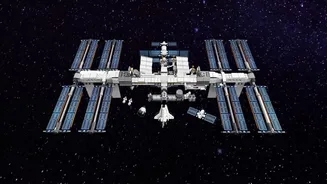
For over two decades, the International Space Station (ISS) has been the sole destination for long-term human presence and microgravity research in low-Earth orbit. However, with the ISS slated for decommissioning around 2030, NASA is actively supporting
a transition to commercially owned and operated platforms. This strategic handover is designed to prevent a gap in research capabilities and foster a robust commercial economy in space. Companies like Axiom Space, Sierra Space, and Vast are at the forefront, developing modular and even inflatable habitats that are not just astronaut apartments, but sophisticated, multipurpose laboratories.
The Orbiting Science Parks of Tomorrow
These next-generation modules are being designed from the ground up with scientific and commercial research as a core function. Unlike the ISS, which was built for a different era, new stations like Starlab are envisioned as 'science parks in space' with integrated research facilities. Starlab, a joint venture including Voyager Space and Airbus, plans to launch a large, single-module station with a significant internal volume dedicated to research. Sierra Space’s LIFE (Large Integrated Flexible Environment) habitat is an inflatable module that launches in a compact form and expands in orbit to the size of a three-story building, complete with labs, medical facilities, and even gardens. Similarly, Vast's Haven-1, planned as the world's first commercial space station, is soliciting research proposals for its dedicated lab, focusing on fields from pharmaceuticals to materials science.
What Kind of Science Gets Done in Space?
The magic ingredient is microgravity. The near-absence of gravity allows for phenomena that are impossible to replicate on Earth. In medicine and biotech, this enables the growth of more perfect protein crystals for drug development and allows for unique stem cell research. In materials science, the lack of gravity-driven sedimentation and convection means purer alloys and higher-quality semiconductors can be fabricated. Companies are already exploring the production of high-value products like superior optical fibers, which are difficult to manufacture on Earth due to gravity-induced imperfections. These orbital labs will allow for faster iteration and development, creating a pipeline from space-based discovery to Earth-based products.
The Business of Breakthroughs
The shift to private stations transforms the business model for space research. Instead of being solely the domain of national space agencies, access is opening up to private companies, universities, and research institutions from around the globe. Companies like Vast are issuing open calls for research proposals, inviting organizations to conduct experiments on their platform. This creates a new market where the 'product' is access to a unique research environment. Axiom Space, which is building its station by first attaching modules to the ISS, expects that by the late 2020s, in-space manufacturing could overtake all its other revenue streams combined. The falling costs of launch, driven by innovators like SpaceX, are a key enabler of this new economy, making it more viable for a wider range of players to participate.