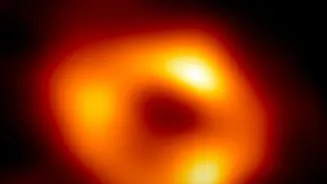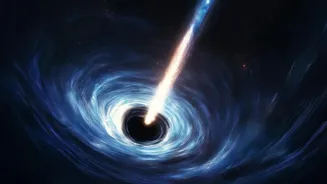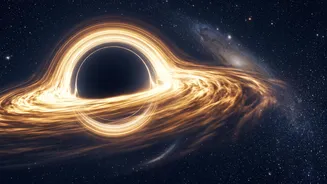




Black holes are the universe's ultimate traps; nothing, not even light, can escape their grasp. But what if these cosmic behemoths aren't as indestructible as we thought? A new study offers a tantalising, theoretical possibility.
The Unbreakable Cosmic Giant
For decades, our understanding
of black holes has been straightforward: they are cosmic vacuum cleaners that only grow. Formed from the collapsed cores of massive stars, their gravitational pull is so immense that once something crosses the 'event horizon', it's gone forever. According to Einstein's theory of general relativity, black holes can merge, becoming larger and more massive in spectacular collisions that send ripples through spacetime. However, the reverse—a single black hole splitting into two—was considered a violation of fundamental physical laws. Specifically, it was believed to go against the second law of thermodynamics, which states that the entropy, or disorder, of a system cannot decrease. For a non-rotating black hole, splitting would do just that, making it a thermodynamic impossibility.
A Crack in the Cosmos?
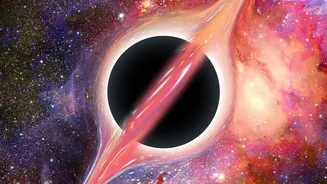
A recent study published in the journal Physical Review D is challenging this long-held assumption. An international team of physicists has explored the extreme conditions under which the laws preventing a black hole from splitting might be bypassed. Their work doesn't suggest that black holes are spontaneously popping in two all over the universe. Instead, they have identified what they call a 'narrow theoretical route' for this to occur, a phenomenon they've termed fragmentation. This isn't an explosion, but a theoretical process where a single event horizon could evolve into a shape resembling a pair of trousers, eventually pinching off to form two separate, smaller black holes.
The 'Narrow Route' Explained
So, what are these highly specific and extreme conditions? The key ingredient is rotation. The researchers calculated that for fragmentation to even be a remote possibility, a black hole would need to be spinning at, or very near to, its maximum possible speed. Such a rapid spin changes the object's relationship with entropy, potentially creating a loophole in the thermodynamic law that normally forbids a split. But even that isn't enough. For the split to be successful, the two newly formed black holes would have to fly apart fast enough to avoid immediately falling back together and merging again. When this additional requirement is factored in, the window of possibility closes almost completely, leaving open only the most extreme, maximally rotating cases.
Beyond Our Three Dimensions
The team, which includes researchers from institutions in Italy, Denmark, and France, also explored how fragmentation might work in more exotic theoretical frameworks. Some models of the universe, like string theory, propose the existence of extra spatial dimensions beyond the three we experience. In these hypothetical scenarios, the researchers found that objects similar to black holes could become unstable and decay, making fragmentation a more thermodynamically favorable outcome. Professor Francesco Sannino, one of the study's authors, cautions that these findings are highly speculative and depend on the nature of gravity at the quantum scale, which remains one of the biggest mysteries in modern physics.
Why This Matters (Even If It's Theory)
While no one has ever observed a black hole splitting, and the conditions required are incredibly rare, this theoretical work is more than just a mathematical curiosity. It pushes the boundaries of our understanding of both general relativity and quantum mechanics. The researchers suggest that if fragmentation does occur, it is more likely for small, primordial black holes—hypothetical objects that may have formed shortly after the Big Bang. The potential signals from such an event, perhaps in the form of high_energy gamma_rays, could one day be searched for by telescopes like the Fermi_LAT. For now, this research provides physicists with a new and extreme scenario to test their theories about how the universe truly works at its most fundamental level.