







The Challenge: A High-Speed Homecoming
After completing its mission in orbit 400 kilometres above Earth, the Gaganyaan crew module will begin its journey home. It will re-enter the atmosphere at hypersonic speeds, using the friction of the air to scrub off most of its velocity in a process
called aerobraking. While the capsule's heat shield protects the astronauts from the extreme temperatures, the module is still travelling too fast for a safe landing. The parachute system is the final, essential step to slow the roughly 5-tonne capsule from over 200 metres per second to a gentle splashdown speed. This deceleration must be perfectly executed to protect both the crew and the spacecraft.
A Ten-Parachute Symphony
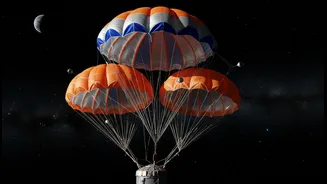
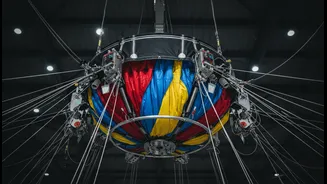
The entire deceleration is a precisely choreographed sequence involving 10 parachutes of four different types. It begins when two Apex Cover Separation parachutes deploy, jettisoning the protective cover that shields the main parachute compartment during re-entry. Next, two drogue parachutes are deployed. These smaller, robust chutes are designed to stabilise the fast-moving capsule, preventing it from tumbling and reducing its speed significantly. Only after the drogue chutes have done their job and are released does the final stage begin. Three pilot chutes emerge, each tasked with pulling out one of the three large main parachutes. It is this trio of main parachutes that handles the final braking, slowing the capsule for a safe landing in the ocean.
Redundancy: The Core of Safety
The key to the system's safety lies in redundancy. ISRO has designed the parachute system to work even if parts of it fail. For example, while there are two drogue parachutes for stabilisation, only one is technically required. The same principle applies to the most critical phase: the main parachutes. The system deploys three main parachutes, but only two are necessary to slow the crew module to a safe landing speed. The third is a complete backup. This 'n+1' philosophy means that a failure of one main parachute would not endanger the mission or the crew. This approach builds a powerful safety margin into the most critical moments of the descent.
Testing for Every Possibility
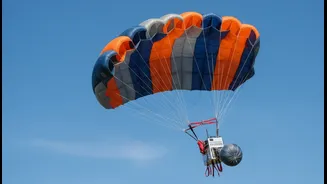
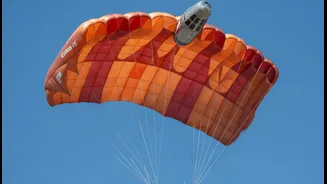
To ensure this complex system is reliable, ISRO, in collaboration with DRDO, has conducted a rigorous series of evaluations called Integrated Air Drop Tests (IADT). In these tests, a mass simulating the crew module is dropped from an Indian Air Force IL-76 aircraft from an altitude of 2.5 kilometres to test the parachute deployment sequence. Crucially, these tests are not just to see if the system works under ideal conditions. ISRO has deliberately simulated failure scenarios, such as one main parachute failing to open, to prove that the redundant design functions as intended. Recent tests, like the fifth in the series (IMAT-05) in July 2026, have successfully validated the main parachutes' strength and reliability, building confidence for the first uncrewed Gaganyaan mission.