



The Myth of 'Zero Gravity'
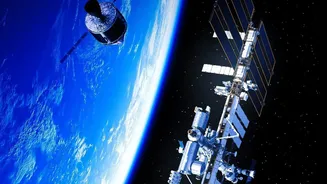
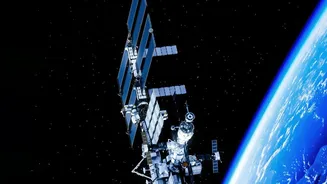
Let's get the biggest misconception out of the way first: astronauts in orbit are not floating because they have escaped Earth’s gravity. The ISS orbits at an altitude of about 250 miles. At that height, Earth's gravitational pull is still about 90% as strong
as it is on the surface. If you could build a ladder that high, a 150-pound person would still weigh 135 pounds at the top. So, gravity is very much present. The term 'zero gravity' is a popular but misleading shorthand for what's actually happening. Gravity is the very force that keeps the station from flying off into deep space.
The Reality: A State of Constant Free-Fall
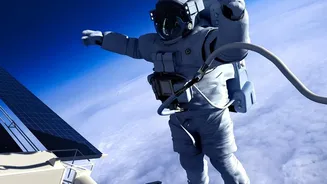
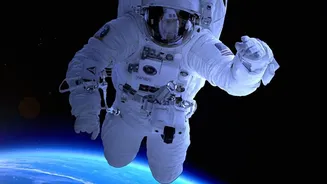
So if gravity is still pulling on them, why do they float? The answer is that the astronauts, the space station, and everything inside it are all in a continuous state of free-fall. Imagine you're in an elevator and the cable snaps. For the few terrifying seconds before it hits the bottom, you and anything you were holding would float relative to each other. You are all falling together at the same rate. This is the core principle behind the feeling of weightlessness in space. Since the astronauts and the station are all falling at the same speed, the astronauts don't press against the floor or walls, and they feel weightless.
An Orbit Is Just Falling With Style
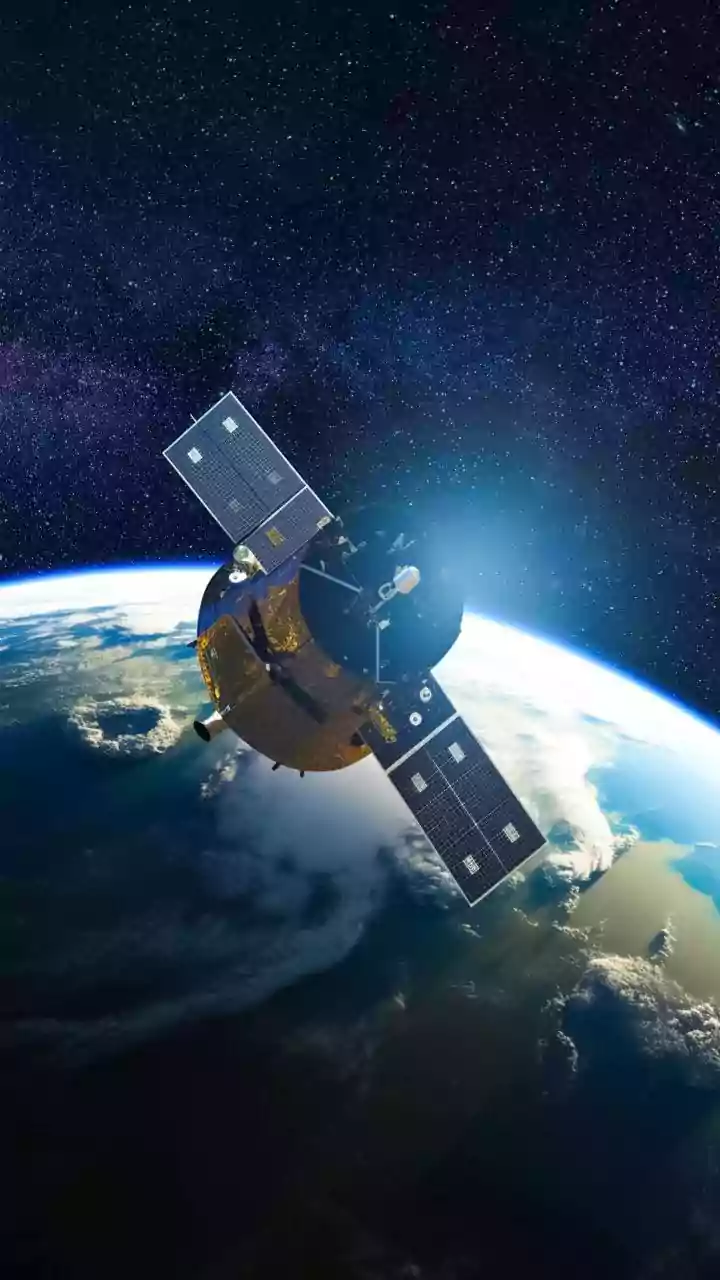
This is where it gets really clever. How can something fall continuously without ever hitting the ground? The secret is sideways speed. Sir Isaac Newton explained this with a famous thought experiment involving a cannon on a very high mountain. If you fire a cannonball, gravity pulls it down and it hits the ground. If you fire it with more speed, it travels further before landing. But if you could fire it at a tremendous speed—about 17,500 miles per hour, to be precise—its forward momentum would be so great that as it falls, the Earth's surface curves away beneath it at the exact same rate. The cannonball is perpetually falling, but it keeps 'missing' the ground. That is exactly what an orbit is: a perfect balance between the constant pull of gravity and the immense forward velocity of the spacecraft.
Why Scientists Prefer the Term 'Microgravity'
While 'free-fall' perfectly describes the main phenomenon, scientists often use a more precise term: 'microgravity'. This is because the environment inside an orbiting spacecraft isn't a perfect, force-free zone. Tiny forces, or micro-accelerations, are still at play. These can be caused by factors like the faint drag from the very thin atmosphere at that altitude, vibrations from machinery on the station, or even the movement of the astronauts themselves. These forces are minuscule—on the order of one-millionth of Earth's surface gravity—but they are technically not zero. Hence, 'microgravity' is the more accurate description of the near-weightless conditions that allow for unique scientific research into everything from fluid physics to the long-term effects of space on the human body.