






A New Era of Lunar Living
For decades, a permanent moon base has been a staple of science fiction. Now, thanks to programs like NASA's Artemis, that vision is becoming a concrete engineering challenge. The goal is to establish a sustainable human presence on the Moon, which would
serve as a vital stepping stone for future missions to Mars and beyond. But launching construction materials from Earth is prohibitively expensive. The solution, which agencies and private companies are actively pursuing, is to 'live off the land'. This means using local resources, and the Moon’s most abundant resource is the loose, dusty material covering its surface: regolith.
The Robotic Construction Crew
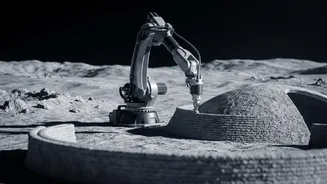
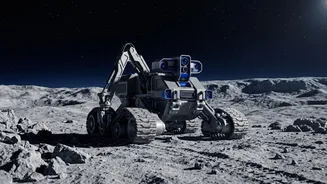
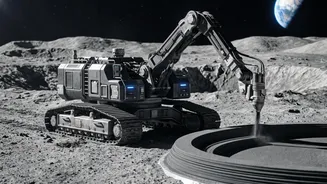
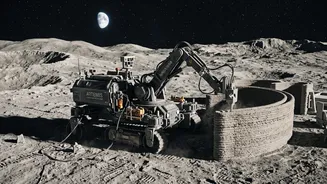
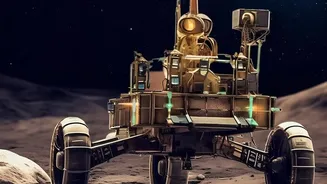
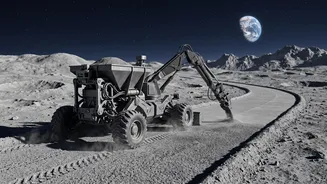
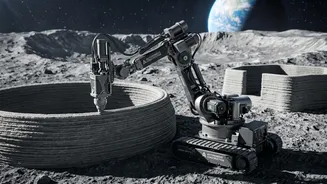
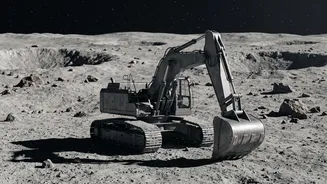
Humans won't be laying the first lunar bricks. That job will belong to autonomous robots. Companies like ICON are developing advanced construction systems, such as their 'Project Olympus', under multi-million dollar NASA contracts. The idea is to deploy fleets of specialized robots that can work together. Some robots will survey and prepare the construction site, while others, equipped with robotic arms and advanced 3D-printing heads, will build structures layer by layer. These systems are being designed to operate in the harsh lunar environment, including vacuum conditions and extreme temperatures, with minimal human oversight. This autonomous approach is crucial for building essential infrastructure like landing pads, roads, and initial shelters before astronauts even arrive.
Building with Moon Dust
Lunar regolith is a challenging but promising building material. It's a mix of fine dust, soil, and broken rock. Scientists are developing several methods to turn this powder into solid structures. The leading technique is 3D printing, where robots would use a focused heat source, like a laser or concentrated sunlight, to melt the regolith and fuse it into a hard, ceramic-like material, a process known as sintering. Another method involves mixing the regolith with a binder to create a type of lunar concrete that can be extruded to form walls and foundations. These techniques are being tested on Earth using 'lunar simulant', a man-made material that mimics the properties of real moon dust. The goal is to create a fully robotic system that can dig up regolith and directly print entire habitats.
A Shield Against Cosmic Dangers
Beyond being a construction material, regolith is also an excellent radiation shield. The Moon has no atmosphere or global magnetic field to protect it from dangerous galactic cosmic rays (GCR) and solar particle events (SPEs). Unprotected astronauts would be exposed to hazardous radiation levels. The simple solution is to pile mass between the astronauts and the radiation. Studies show that a layer of regolith several feet thick can significantly reduce radiation exposure to safe levels. Future habitats, like AI SpaceFactory's proposed LINA outpost, are designed with thin inner shells that would then be covered by a thick layer of 3D-printed or piled-up regolith, providing robust protection from radiation, as well as micrometeoroid impacts and extreme temperature swings.
Overcoming Lunar Hurdles
Building on the Moon is not without immense challenges. The abrasive and static nature of lunar dust can damage moving parts and clog machinery. Extreme temperature fluctuations, from scorching hot to freezing cold, put immense stress on materials and equipment. Furthermore, all robotic operations must contend with communication delays and the need for a high degree of autonomy, as direct real-time control from Earth isn't always feasible. Robots must be able to handle irregular materials, troubleshoot problems, and work together as a coordinated team to succeed. Testing these systems in simulated lunar environments on Earth is a critical step before they are deployed hundreds of thousands of miles away.