




A Sweet Discovery in the Cosmos
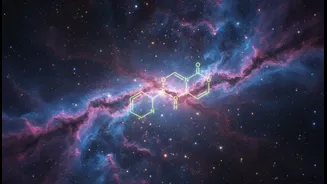
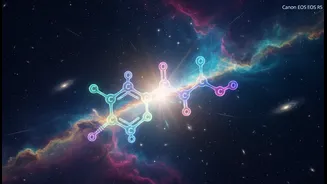
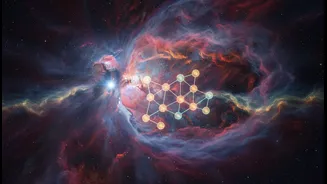
An international team of researchers has announced the first-ever direct detection of a true sugar in interstellar space. The molecule, called erythrulose, was found in a vast cloud of gas and dust known as G+0.693-0.027, located near the heart of the Milky
Way. Using powerful radio telescopes in Spain, scientists identified the unique radio-wave signature of erythrulose, a four-carbon sugar also found naturally in raspberries. This discovery is significant because while sugar-like molecules and even some sugars have been found in meteorites before, this is the first time a true sugar has been spotted in the interstellar medium—the raw material from which stars and planets are born.
More Than Just Sugar Water
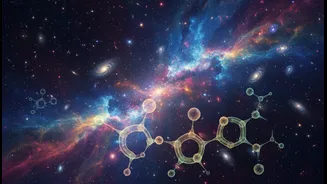
Erythrulose is not just any sugar; it's a relatively complex one for the harsh environment of space. With a structure containing four carbon atoms, it is more complex than other simpler molecules previously thought to be the norm. In fact, researchers were surprised to find that erythrulose was at least eight times more abundant than any simpler, three-carbon sugars in the same cloud. This challenges theories that molecules in space grow slowly by adding one carbon atom at a time. More importantly for the origin of life, erythrulose is considered a potential precursor to molecules like ribose, the sugar that forms the backbone of RNA, a cornerstone of life as we know it.
How to Spot a Molecule Quadrillions of Miles Away
Detecting a specific molecule from over 26,000 light-years away is a monumental feat of science. Astronomers use a technique called radio astronomy. Every molecule vibrates and rotates, emitting faint radio waves at specific, predictable frequencies, creating a unique spectral "fingerprint." Scientists first measure this fingerprint for erythrulose in a lab. Then, they point powerful radio telescopes, like the Yebes 40-m and IRAM 30-m telescopes used in this study, at a target cloud. By sifting through a massive amount of radio signals from the cloud, they search for a match. In this case, they found 12 spectral lines that perfectly matched the signature of erythrulose, confirming its presence.
Hold Your Horses on the Alien Hype
So, does finding sugar in space mean we’ve found aliens? In a word: no. It is crucial to distinguish between prebiotic chemistry and biology. Finding erythrulose means that a key building block of life can form naturally in space through chemical processes that do not involve living organisms. Scientists believe these molecules form on the surfaces of icy dust grains floating in space. These are ingredients, not the finished cake. As NASA scientist Daniel Glavin said regarding similar findings on asteroid Bennu, "We found the pieces of the jigsaw puzzle for life that had not yet come together to form life." This discovery shows the universe is rich in the raw materials for life, not that life itself is widespread.
The Cosmic Recipe for Life
This discovery adds a crucial new ingredient to our understanding of the cosmic recipe for life. It provides strong evidence for the theory of panspermia, which suggests that life on Earth may have been kickstarted by ingredients delivered from space via comets and asteroids billions of years ago. Finding complex sugars forming in interstellar clouds, before stars and planets even exist, means these essential building blocks could be incorporated into new planetary systems across the galaxy. It reinforces the idea that the chemical conditions necessary for life to emerge might be common throughout the universe, bringing us one step closer to understanding not just our own origins, but the potential for life elsewhere.