





Earth's 'Evil Twin' and a Climate Cautionary Tale
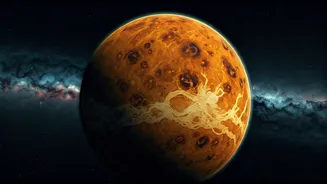
Venus is often called Earth’s twin. Both are rocky planets of a similar size and were formed from the same cosmic ingredients. But their paths diverged dramatically. While Earth became a haven for life, Venus devolved into the hottest planet in the solar
system, with surface temperatures that can melt lead. This transformation is believed to have been caused by a runaway greenhouse effect, a scenario where the atmosphere traps so much heat that oceans boil away and the climate spirals out of control. For climate scientists, Venus is not just a celestial curiosity; it is a natural laboratory for studying the most extreme consequences of an atmospheric imbalance. Understanding how Venus turned into a furnace provides critical insights into the physical laws that govern planetary climates, including our own.
Enter Shukrayaan: India's Venusian Explorer
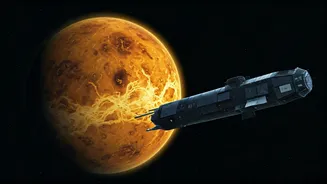
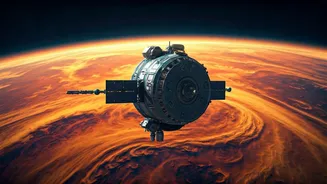
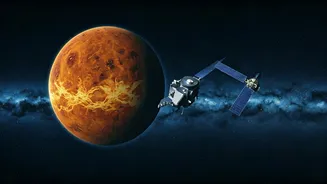
The Indian Space Research Organisation (ISRO) is planning its first-ever mission to Venus, named Shukrayaan-1. Formally approved by the Union Cabinet in September 2024, the Venus Orbiter Mission is scheduled for a potential launch in March 2028. After a journey of over 100 days, the orbiter will settle into a highly elliptical orbit around the planet. Its primary goal is to study Venus in a comprehensive manner: its surface and sub-surface, its complex atmosphere, and its interaction with the solar wind. The mission will carry a suite of advanced Indian and international instruments designed to peer through the planet's thick, toxic clouds and unlock its secrets.
Lessons from a Runaway Greenhouse
The core interest for climate scientists lies in Shukrayaan's atmospheric studies. Venus's atmosphere is over 96% carbon dioxide, creating the most powerful greenhouse effect known in the solar system. By studying its structure, composition, and dynamics, scientists hope to better understand the mechanisms that drive such extreme climate states. This data is crucial for testing and refining the complex computer models used to predict climate change on Earth. While Earth is not in immediate danger of becoming Venus, understanding the tipping points and feedback loops that led to Venus’s climate catastrophe can sharpen our own forecasts and serve as a stark cautionary tale about planetary habitability.
The Tools for the Job
Shukrayaan-1 will be equipped with about 100 kg of scientific instruments to carry out its investigation. A key instrument is a high-resolution Synthetic Aperture Radar (SAR), which can penetrate the dense sulfuric acid clouds to map the planet’s surface with unprecedented detail. Another groundbreaking tool is a ground-penetrating radar, which would be the first instrument ever to study the subsurface of Venus. Other payloads will analyze atmospheric chemistry, track cloud movements, and study how the solar wind strips away atmospheric particles—a process that may have contributed to the loss of Venus's ancient oceans. This holistic approach, combining surface, subsurface, and atmospheric data, makes it a uniquely comprehensive mission.
Refining Our Planet's Future
Ultimately, the data beamed back from Shukrayaan-1 will feed directly into the work of scientists here in India and across the globe. By providing a real-world example of a greenhouse effect pushed to its absolute limit, the mission offers a unique chance to validate and improve the climate models that are essential for policy-making and mitigation strategies on Earth. The mission will join a new wave of international efforts to explore Venus, including missions from NASA and the European Space Agency, creating a powerful global collaboration to understand our twin planet. For Indian climate scientists, ISRO's journey to Venus is not about escaping Earth's problems, but about gaining a new perspective to better protect our own fragile home.