

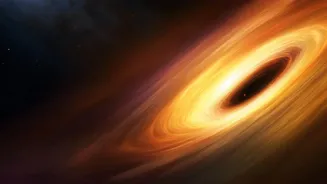
Our galaxy is thought to host millions of stellar-mass black holes, yet we have found only a tiny fraction of them. A new project, Black Hole Hunters, is changing the game by searching for these invisible objects using a clever gravitational clue.
The Galaxy’s Missing Inhabitants
Astronomers
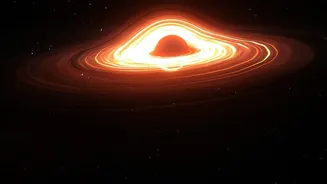
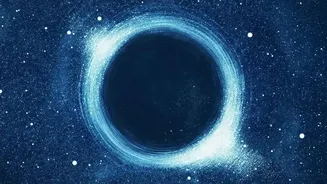
estimate there could be anywhere from 10 to 100 million stellar-mass black holes scattered throughout our Milky Way galaxy. These are the remnants of giant stars, at least 20 times the mass of our sun, that collapsed under their own gravity after exhausting their fuel. Despite their predicted abundance, we have only directly identified a small number, perhaps around 70. The reason for this discrepancy is simple: most black holes are invisible. We typically find them when they are actively 'feeding' on a nearby companion star, a process that heats up material and causes it to glow brightly in X-rays. But a solitary black hole, or one that isn't currently siphoning material from a partner, is dark and silent, drifting through space like a ghost. This makes a complete census of our galaxy's black holes incredibly difficult, leaving a huge gap in our understanding of how stars live and die.
A Trick of Light and Gravity
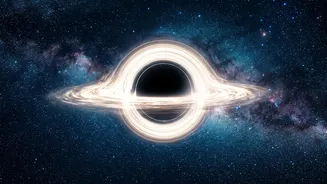
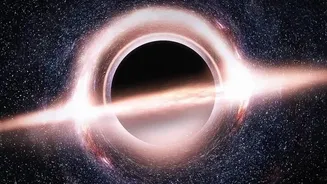
To find these invisible giants, astronomers are turning to a fascinating cosmic phenomenon predicted by Albert Einstein: gravitational lensing. According to the theory of general relativity, a massive object warps the fabric of spacetime around it. This curvature acts like a lens, bending the path of light that passes nearby. The Black Hole Hunters project looks for a specific type of this effect called microlensing. When a black hole passes almost directly in front of a distant star from our point of view, its intense gravity acts as a natural magnifying glass. It bends and focuses the star's light, causing the star to appear to temporarily brighten in a very specific and predictable way. By watching for this telltale flicker, scientists can infer the presence of a massive, dark object that would otherwise remain completely unseen.
The Hunt for a Telltale Glow
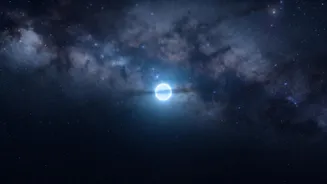
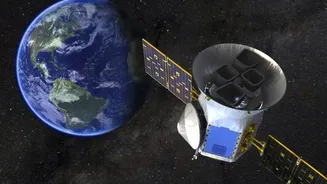
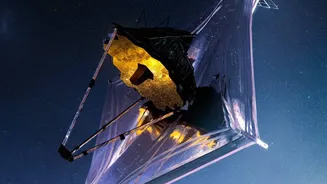
The signal that hunters are searching for is a unique pattern of brightening and dimming. As the black hole moves in front of the star, the star's light will smoothly increase to a peak brightness and then fade back to normal in a perfectly symmetrical curve. This signature helps distinguish a microlensing event from other phenomena, like a star flaring or pulsating. The duration of the brightening is also a key clue. A longer-lasting event suggests the lensing object is more massive. Events caused by planets or normal stars tend to be shorter, while a lensing event caused by a black hole could cause a star to brighten for many months. The project sifts through enormous amounts of data, primarily from NASA’s Transiting Exoplanet Survey Satellite (TESS), which monitors the brightness of hundreds of thousands of stars.
Why Human Eyes Are the Secret Weapon
With millions of stars to monitor, the task of finding these rare signals is monumental. While automated algorithms can perform a first pass on the data, they often struggle with the 'messy' reality of the cosmos. Things like stellar flares, instrument glitches, or natural star pulsations can trick computers into flagging false positives. This is where citizen scientists come in. The Black Hole Hunters project, hosted on the Zooniverse platform, enlists volunteers to visually inspect graphs of stellar brightness, known as light curves. The human brain is exceptionally good at pattern recognition, able to spot the subtle, symmetrical brightening of a potential lensing event amidst the noise. No astronomy degree is required; volunteers are shown examples of what to look for and simply flag the patterns that match. This human touch is crucial for creating a reliable shortlist of candidates for professional astronomers to investigate further.
Completing the Cosmic Census
Every black hole discovered through this method adds a vital piece to a grand cosmic puzzle. Finding and counting these isolated black holes will help astronomers refine their theories on star formation and evolution. It provides crucial data on how many massive stars end their lives as black holes versus other remnants like neutron stars. It also helps us understand the distribution of mass within our galaxy and how these wandering objects might influence their surroundings over millions of years. The project is focused on the hunt itself, as finding a confirmed 'self-lensing' system with a black hole would be a first of its kind. Each potential candidate identified by a volunteer could lead to a new understanding of the dark, unseen population of our galactic neighbourhood.