




The Trailblazing Trio
Until recently, the idea of finding an object from another star system was purely theoretical. That changed in 2017 with the discovery of 1I/‘Oumuamua, a strange, cigar-shaped object that tumbled through our solar system on a path that confirmed its interstellar
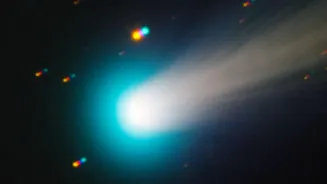
origin. Then, in 2019, came 2I/Borisov, a more familiar-looking comet that also hailed from beyond our Sun's influence. Most recently, in July 2025, the NASA-funded ATLAS survey spotted the third confirmed visitor: 3I/ATLAS. Discovered inside the orbit of Jupiter, this object was confirmed to be a comet on a hyperbolic trajectory, meaning it was moving too fast to be captured by the Sun's gravity. These three discoveries have given us our first-ever glimpse of the building materials from other planetary systems, offering priceless clues about how planets form elsewhere in the galaxy.
The Next-Generation Hunter
Finding these objects has so far involved a bit of luck. They are faint, fast, and we have to be looking in the right place at the right time. That is about to change dramatically with the Vera C. Rubin Observatory in Chile. After a decade of construction, the observatory began its commissioning phase in 2025 and is set to revolutionize the search for transient events. Its power lies in a massive 8.4-meter telescope and the largest digital camera ever built for astronomy, which will scan the entire southern sky every few nights. This unprecedented combination of depth and speed means Rubin is uniquely capable of catching faint, fast-moving objects that previous surveys would have missed. While we’ve only found three interstellar objects so far, scientists estimate Rubin could detect dozens per year, transforming our understanding from a few isolated case studies into a true population study.
Ready for a Close-Up
Detecting these visitors is one thing; studying them up close is another challenge entirely. Interstellar objects move so quickly that by the time we spot them, we have little time to plan and launch a mission. The European Space Agency (ESA) has a clever solution: the Comet Interceptor mission, planned for launch around 2029. This unique spacecraft won't have a predetermined target. Instead, it will travel to a stable parking spot in space, the Sun-Earth L2 point, and wait. For up to three years, it will lie dormant until a suitable target—a pristine, long-period comet or, ideally, an interstellar object—is found on an achievable trajectory. Once a target is identified, the spacecraft will travel to meet it. Just before arrival, it will split into three separate probes that will perform simultaneous observations, creating a 3D profile of the object's nucleus and the gas and dust surrounding it.
Why the Search Matters
The hunt for interstellar objects is about more than just cosmic sightseeing. These visitors are time capsules from other solar systems. By studying their chemical makeup, shape, and structure, we can learn about the conditions in the planetary systems where they formed. Are the building blocks of planets—and perhaps life—the same across the galaxy? Are solar systems like ours common or rare? Answering these questions has been the work of remote observation, looking at distant stars through telescopes. Interstellar objects bring pieces of those systems directly to us, offering a revolutionary opportunity for what amounts to extraterrestrial geology. Visiting one with a mission like Comet Interceptor is our best chance in the foreseeable future to physically explore a piece of another star system.