





A World Transformed by a Flyby
Before 2015, our best images of Pluto were fuzzy dots from even the most powerful telescopes. It was easy to assume the dwarf planet, orbiting more than 3 billion miles from the Sun's warmth, was a simple, cratered ball of ice, geologically dead for billions
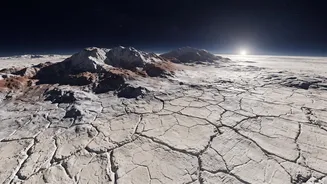
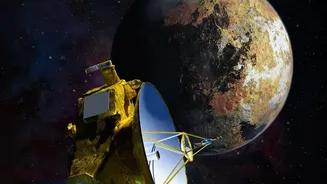
of years. That assumption was shattered when NASA's New Horizons spacecraft flew past Pluto, revealing a stunningly complex and diverse world. The probe sent back images of vast nitrogen-ice glaciers, towering mountains of water ice, and a surprisingly youthful surface in many regions, most notably the western lobe of its famous heart-shaped feature, Sputnik Planitia. This vast plain, larger than Texas and Oklahoma combined, was almost entirely free of impact craters, a clear sign that its surface was being actively renewed. The question was no longer if Pluto was active, but how active, and for how long.
Signs of Flowing Liquid Nitrogen
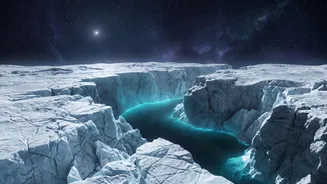
The latest chapter in this story comes from a fresh analysis of the New Horizons data, published in The Planetary Science Journal. Scientists focused on strange dark streaks and patches found along the edges of the city-sized convection cells that make up Sputnik Planitia. These markings look remarkably similar to features on Earth's own ice sheets, where meltwater darkens the surface. Of course, it's far too cold on Pluto for liquid water. Instead, researchers propose that the culprit is liquid nitrogen. While nitrogen rain is impossible in Pluto's thin, frigid atmosphere, computer models suggest a fascinating alternative. The immense pressure from the miles-deep nitrogen glacier could be enough to melt the nitrogen ice at its base. This buoyant liquid nitrogen could then be forced upward through cracks and fissures, briefly wetting the surface before it refreezes, creating the dark features New Horizons observed.
The Cryovolcano Conundrum
Beyond flowing glaciers, other research points to an even more dramatic form of recent activity: cryovolcanism. Instead of molten rock, these ice volcanoes would have spewed a slushy mix of water, ice, and other compounds like ammonia from Pluto's interior. Scientists have identified several large mounds with central depressions, such as the massive Wright Mons, that strongly resemble volcanoes. The lack of impact craters in the surrounding area suggests this activity happened in the relatively recent geological past—perhaps only 100 to 200 million years ago. Some studies have even identified a potential 'supervolcano' that could have scattered over a thousand cubic kilometers of icy cryomagma across the surface. This evidence implies that Pluto may have retained more internal heat from its formation and the decay of radioactive elements than previously thought possible for such a small world.
Why a 'Living' Pluto Matters
The ongoing investigation into Pluto's activity is more than just a cosmic curiosity. It forces a fundamental rethink of how planetary bodies work, especially in the cold, distant Kuiper Belt. Small, icy worlds were not expected to have enough internal heat to power geological processes for billions of years. Pluto is proving that rule wrong. The possibility of liquid nitrogen seeping to the surface, or a still-warm interior capable of powering cryovolcanoes, suggests that the conditions for dynamic geology are more common in the solar system than we knew. This discovery has even raised the faint, tantalizing possibility of a subsurface liquid water ocean, kept from freezing by ammonia and residual heat, which could be a source for the icy eruptions. Each new finding reinforces the idea that the solar system's most distant worlds are not dead relics, but complex and evolving places that still hold many secrets.