





The Martian Survival Dilemma
Surviving on Mars is a daunting logistical problem. The planet’s atmosphere is about 96% carbon dioxide, with only a trace amount of oxygen, making it instantly lethal to humans. For any long-term mission, astronauts would need a constant supply of breathable
air. Furthermore, getting home requires an enormous amount of propellant—specifically, an oxidiser like liquid oxygen to mix with fuel. Current estimates suggest a Mars ascent vehicle would need around 30 metric tons of oxygen. Launching all that oxygen from Earth is prohibitively expensive and risky, adding immense weight to any spacecraft. The solution lies in a concept known as In-Situ Resource Utilisation (ISRU), which essentially means living off the land by using local Martian resources.
A Real-World Test: The MOXIE Experiment
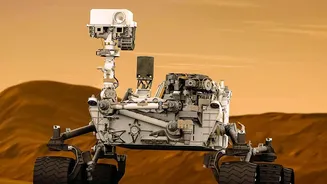
The first major step in proving this concept was NASA's Mars Oxygen In-Situ Resource Utilization Experiment, or MOXIE. This lunchbox-sized device travelled to Mars aboard the Perseverance rover and, for the first time, extracted oxygen from another planet's atmosphere. The process, called solid oxide electrolysis, involves pulling in Martian air, compressing it, and heating it to around 800 degrees Celsius. An electrical current then splits the carbon dioxide molecules into breathable oxygen and carbon monoxide. Between 2021 and 2023, MOXIE ran 16 times, successfully producing high-purity oxygen and proving that the core technology works in the harsh Martian environment. While it only made about 122 grams of oxygen in total, it was a crucial proof of concept.
Enhancing the Recipe: From Oxygen to Fuel
The next step is to go beyond simply making oxygen. This is where “enhanced” reactors come in. The most promising enhancement is co-electrolysis, a process being developed by groups like the Idaho National Laboratory. Instead of only processing carbon dioxide, these advanced reactors can simultaneously split both CO2 from the atmosphere and water (H2O) mined from Martian ice. This single, efficient process generates two critical outputs: pure oxygen and syngas, a mixture of hydrogen and carbon monoxide. This syngas can then be chemically converted into methane (CH4), a high-performance rocket fuel. This transforms a simple oxygen generator into a complete life support and fuel production plant, allowing astronauts to create both breathable air and the propellant needed for their return journey.
The Next Generation: Scaling Up for Humans
MOXIE was a small-scale demonstrator; future missions will need a system capable of producing kilograms of oxygen per hour, not just a few grams. Researchers are now designing full-scale ISRU plants based on MOXIE’s success, envisioning larger reactors that run continuously for months to produce the tons of oxygen needed. Other promising technologies are also emerging. Scientists are experimenting with plasma reactors that can split CO2 using 'small lightning bolts' in a chamber. Prototypes have already shown they can produce oxygen far more efficiently than MOXIE and at ambient Martian temperatures, which could drastically reduce the massive power requirements of high-heat electrolysis. These next-generation systems represent the scaled-up, industrial version of the technology needed to support a human crew.
Why This Changes Everything for Exploration
These enhanced CO2 electrolysis reactors are a breakthrough because they directly address one of the biggest hurdles to a sustainable human presence on Mars. The ability to generate oxygen and fuel on-site fundamentally changes mission architecture. It dramatically reduces the mass that needs to be launched from Earth, which in turn cuts costs and complexity. It makes missions safer by providing a reliable, on-demand source of life support and a way home that isn't entirely dependent on supplies brought from 100 million miles away. This technology shifts the paradigm from merely visiting the Red Planet to establishing a long-term, semi-independent foothold there. It is the key to unlocking the next chapter of human space exploration.