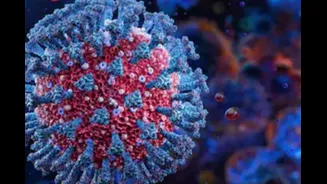







What Is the PJ.2.1 Variant?
PJ.2.1 is a new lineage of the SARS-CoV-2 virus, the one that causes COVID-19. It is a descendant of the JN.1 family, which belongs to the broader Omicron group of variants. It was first identified in a sample from Ontario, Canada, on May 2, 2026. Since
then, it has been detected across North America, Europe, Australia, and parts of Asia, including Singapore. Scientists refer to it as a 'saltation variant', which means it appeared with a large number of genetic changes at once, rather than evolving slowly. Many of these changes are on the spike protein, the part of the virus that attaches to our cells. This has led researchers to investigate its behaviour closely.
Assessing Spread and Symptoms
The rapid intercontinental spread has caught the attention of the World Health Organization (WHO), which is closely monitoring the variant. In some regions, like Ontario, its prevalence among sequenced cases grew from just over 1% in July to more than 25% by mid-October 2026. This suggests it may have a growth advantage. Laboratory studies have found that PJ.2.1's spike protein binds more effectively to the ACE2 receptor, the 'doorway' into human cells. This might help explain its spread, but it doesn't automatically mean it's more dangerous in the real world. As for symptoms, there is no unique profile for PJ.2.1. Infected individuals report common COVID-19 symptoms like a sore throat, cough, fever, runny nose, headache, and fatigue, which are very similar to the flu or a common cold. This makes it impossible to identify the variant by symptoms alone; a diagnostic test is required.
Why Experts Advise Against Alarm
Despite its spread, the key message from health experts is that there is currently no evidence PJ.2.1 causes more severe disease. Doctors and health officials emphasize that there isn't enough data to link the variant to higher rates of hospitalization, complications, or death. While some reports mention a potentially more severe sore throat or prolonged fatigue, these have not been established as distinct clinical features of the variant. Dr. Asher Jamal, an emergency physician, noted that while new variants will continue to emerge, hospitals are not seeing the same severity or pressure on services as in earlier stages of the pandemic. The WHO has not listed PJ.2.1 as a 'variant of concern' or 'variant of interest'.
The Role of Immunity and Vaccines
An important piece of the puzzle is how PJ.2.1 interacts with our existing immunity. Encouragingly, laboratory research has found that the variant does not seem to be significantly better at evading antibodies from vaccination compared to other recent variants. One study found that antibodies from people who had received an updated vaccine were still effective at neutralizing PJ.2.1, with only a small reduction in potency. This suggests that current vaccines continue to offer valuable protection against severe outcomes. While lab results don't perfectly predict real-world effectiveness, they provide a strong indication that our immune systems are not starting from scratch against this new lineage.
Monitoring the Situation in India
As of mid-November 2026, there has been no official public confirmation that PJ.2.1 has been detected in India. The Indian SARS-CoV-2 Genomics Consortium (INSACOG) is the agency responsible for monitoring genetic changes in the virus across the country through its network of labs. While its public data has not yet listed PJ.2.1, the detection of a variant is a testament to the success of such surveillance systems. Their role is to identify new lineages early, allowing public health bodies to assess the risk and respond appropriately. Experts advise that while there is no cause for immediate alarm, continued monitoring of infection patterns and hospitalizations is crucial.