





The Astronaut with a Doctor's Bag
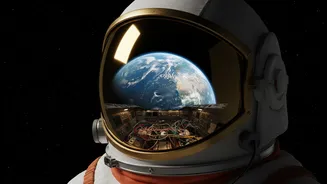
Anil Menon is not your typical astronaut, if such a thing even exists. The son of Indian and Ukrainian immigrants, his resume is a testament to a life spent at the intersection of extreme environments and medicine. An emergency room physician and a Lieutenant
Colonel in the U.S. Air Force, Menon's career has taken him from providing medical care during earthquakes in Haiti and Nepal to serving as a first responder at the Reno Air Show accident. He’s also served as a flight surgeon, logging over 100 sorties in an F-15 fighter jet. Before being selected as one of ten astronaut candidates from over 12,000 applicants in 2021, Menon was SpaceX's very first flight surgeon. In that role, he helped launch the first humans on a commercial spacecraft and built the medical organisation to keep them safe. His upcoming eight-month mission to the ISS is a culmination of this unique expertise.
Space: The Ultimate Hostile Environment
Space is relentlessly hostile to the human body, which is finely tuned to Earth’s gravity and protective magnetic field. In the microgravity environment of the ISS, astronauts face a barrage of physiological challenges. Without the constant pull of gravity, fluids shift upwards, causing the familiar “puffy face” seen in astronauts and increasing pressure on the brain and eyes, which can lead to vision problems known as Spaceflight-Associated Neuro-Ocular Syndrome (SANS). Bones, no longer needing to bear weight, lose density at a rate of about 1% to 1.5% per month—a rate of decay far faster than osteoporosis on Earth. Muscles atrophy, the cardiovascular system deconditions, and the immune system can become suppressed. On top of this is the constant threat of radiation from galactic cosmic rays, which increases the lifetime risk of cancer and other degenerative diseases.
The Role of Space Medicine
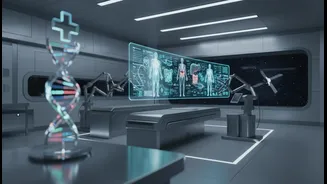
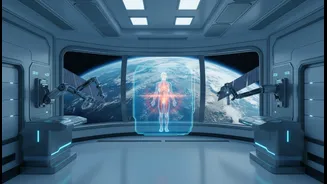
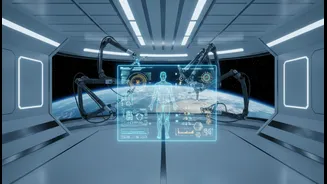
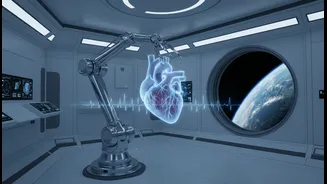
This is where space medicine comes in. It's a specialized field dedicated to keeping astronauts healthy in an environment where a hospital is not an option. A flight surgeon like Menon is responsible for everything from pre-flight preventative care to managing medical emergencies in orbit. During his mission, Menon will conduct experiments studying how microgravity affects blood flow and composition, and test technologies for producing IV fluids from the station’s water supply—a critical capability for future deep-space missions where resupply is impossible. This isn't just about monitoring health; it's about actively developing countermeasures—like specific exercise regimens, nutritional plans, and medical technologies—that allow humans to function for long periods off-planet.
Why It Matters More Than Ever
Menon's work is crucial because humanity's ambitions are stretching beyond low-Earth orbit. As NASA's Artemis program aims for a sustained presence on the Moon and future missions eye Mars, the stakes for space medicine get exponentially higher. A trip to Mars could take years, and the communication delay can be up to 22 minutes one-way, making real-time consultation with doctors on Earth impossible. An astronaut crew on Mars will need to be medically autonomous, capable of handling everything from a bone fracture to a sudden, unexplained medical episode. The research being done on the ISS today is building the foundation for that autonomy, figuring out how to diagnose and treat illnesses with limited equipment and without the possibility of a quick evacuation.
Lessons for India's Gaganyaan Mission
The focus on space medicine holds particular relevance for India. As ISRO moves forward with its ambitious Gaganyaan human spaceflight programme, ensuring the health and safety of its 'Gaganauts' is paramount. ISRO has already signed agreements with medical institutes like AIIMS to advance research in space medicine, focusing on areas like human physiology under microgravity, radiation biology, and biomedical support systems. The learnings from missions like Menon’s will provide invaluable data, informing everything from crew selection and training to the design of life support systems and medical kits for India's future astronauts. In a very real sense, the path to putting an Indian in orbit runs directly through the discipline that Anil Menon champions.