



Peering Inside Planetary Nurseries
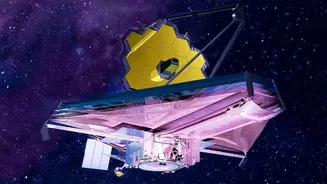
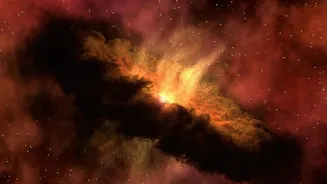
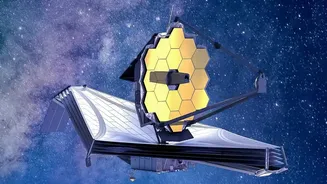
Planets form within vast, pancake-like disks of gas and dust that swirl around young stars. These protoplanetary disks are dense and opaque, making it difficult for most telescopes to see what is happening inside. This is where Webb’s specialty comes
in. By detecting infrared light, which can pass through these thick dust clouds, the telescope allows scientists to witness the conditions in the innermost regions of these disks, the very zone where rocky, Earth-like planets are expected to form. This capability has provided a revolutionary view of the conditions that precede the birth of planets and ultimately determine their composition.
A Diverse Chemical Cookbook
One of Webb’s most significant contributions is its ability to take a chemical inventory of these planet-forming regions. Webb’s spectrographs act like cosmic prisms, breaking down the faint light from these distant disks to reveal the chemical fingerprints of the molecules within. So far, the discoveries have revealed that the chemical environments where planets form are incredibly diverse. Webb has detected a rich assortment of molecules essential for building worlds, including water (H2O), carbon dioxide (CO2), methane (CH4), and hydrogen cyanide (HCN). It has even found more complex organic hydrocarbons like acetylene (C2H2) and benzene (C6H6), a molecule never before seen in a protoplanetary disk.
The Search for Water and Carbon
Two ingredients are of particular interest to astronomers: water and carbon. Water is essential for life as we know it, and carbon forms the backbone of all organic molecules. Webb has confirmed that icy pebbles from the colder, outer regions of a disk can drift inward, releasing large amounts of water vapour as they warm up. In some systems, this creates a water-rich environment right where terrestrial planets would be assembling. However, not all disks are the same. In one surprising case, a disk around the star XUE 10 was found to be unexpectedly low in water but had a high concentration of carbon dioxide. In another, around the exoplanet CT Cha b, Webb found a carbon-rich disk that scientists are calling a potential 'moon factory'. This chemical diversity suggests that different planetary systems may have very different starting materials, which could influence the habitability of the planets that eventually form.
Extending the Planet-Forming Timeline
Previously, astronomers believed these planetary nurseries were short-lived, dissipating in about 10 million years, creating a race against time for planets to form. However, Webb's observations have challenged this notion. Studies of small, low-mass stars show their planet-forming disks can last much longer, sometimes up to 30 million years. Research into a nearby dwarf galaxy, which mimics conditions in the early universe, also revealed longer-lived disks. This extended timeline means that planets, including large gas giants, have more time to gather material and grow. These findings force scientists to rethink models of how quickly planets must come together, suggesting the window for planet formation might be wider than we thought, especially in different stellar environments.
From Icy Pebbles to New Worlds
Webb is also providing a clearer picture of how planets are physically constructed. In our own outer solar system, Webb and Hubble jointly studied dozens of small, icy bodies beyond Neptune, which are leftover building materials from our solar system's early days. They found fewer small objects than some models predicted, suggesting the process of planetesimals—city-sized building blocks—clumping together might be more efficient than previously thought. By studying the chemical makeup of disks where planets are forming now, and comparing it to the leftover debris in our own system, astronomers can piece together the complete story of how a chaotic swirl of gas, dust, and ice evolves into stable solar systems with diverse planets.