


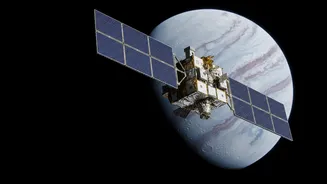
An Epic Journey to an Ocean Moon
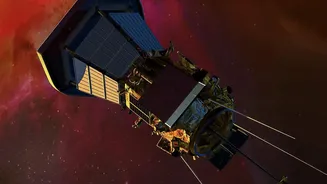
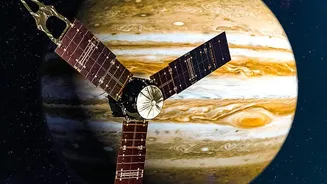
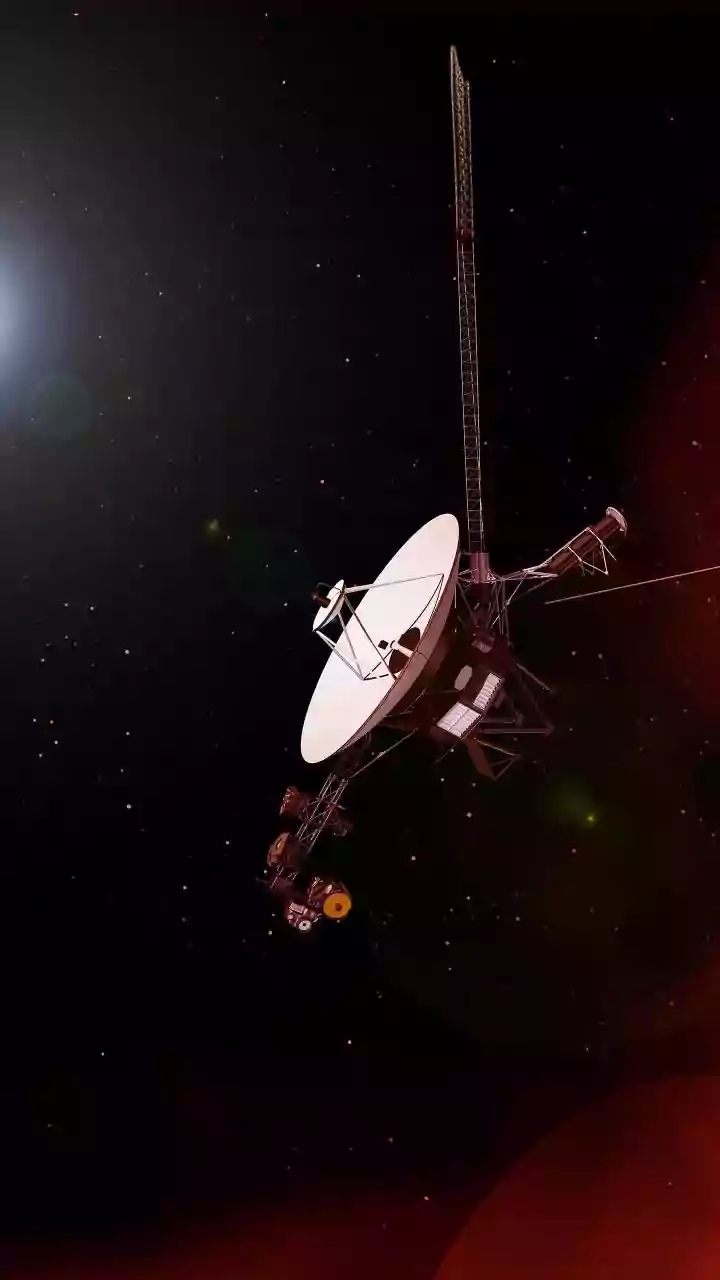
Launched in October 2024, the Europa Clipper is a sophisticated, basketball-court-sized spacecraft on a multi-year, nearly 3-billion-kilometre journey to Jupiter. Its destination is not the gas giant itself, but one of its most fascinating moons: Europa.
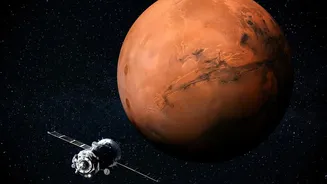
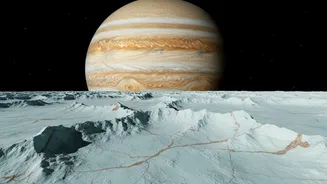
Scientists have compelling evidence that beneath Europa's bright, icy crust lies a vast, deep ocean of liquid saltwater, potentially holding more than twice the water of all of Earth's oceans combined. The Clipper's primary goal isn't to find life directly, but to perform the first detailed reconnaissance of this ocean world and determine if it possesses the necessary ingredients for life to exist. To get there, it's taking a scenic route, using a gravity-assist flyby of Mars in 2025 and a final slingshot past Earth in late 2026 to gain the speed needed for its long trip to the outer solar system.
Why Europa Holds Such Promise
On Earth, wherever we find water, we find life. This simple fact makes Europa one of the most tantalizing targets in our solar system. Though its surface is frozen solid, Europa is warmed from within. Its slightly eccentric orbit around Jupiter causes immense gravitational forces to constantly stretch and flex the moon’s interior, a process called tidal heating. This internal energy is believed to keep the subsurface ocean liquid and could even power hydrothermal vents on the seafloor. On Earth, such vents in the deep, dark ocean are oases for life, which thrives on chemical energy instead of sunlight. If similar geology exists on Europa, it could provide the energy and chemical nutrients needed to sustain a habitable environment, completely independent of the Sun.
A Toolkit for Habitability
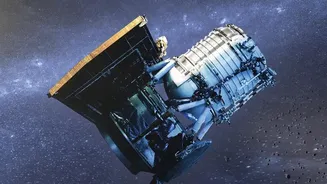
To peer beneath the ice, Europa Clipper is equipped with a suite of nine advanced scientific instruments. These tools are designed to work together to create a comprehensive picture of the moon. An ice-penetrating radar will measure the thickness of the icy shell and search for pockets of water trapped within it. Spectrometers will analyze the chemical composition of the surface, mapping the distribution of ices, salts, and organic compounds. A magnetometer will measure the strength and direction of the moon's magnetic field, which can help confirm the existence, depth, and saltiness of the subsurface ocean. High-resolution cameras will produce detailed maps of the fractured surface, looking for geologic activity and potential future landing sites.
Skimming the Surface for Clues
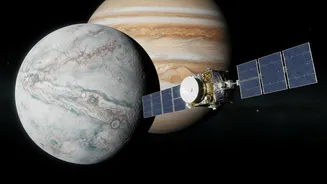
Exploring Europa is challenging due to the intense radiation belts surrounding Jupiter, which can destroy a spacecraft's electronics. To manage this risk, Clipper won't orbit Europa directly. Instead, after arriving at the Jupiter system in April 2030, it will enter a long, looping orbit around the gas giant itself. From there, it will perform dozens of close, rapid flybys of Europa, some as low as 25 kilometers above the surface. This strategy allows the spacecraft to collect a massive amount of data while minimizing its exposure to the harshest radiation. During these flybys, instruments will also search for one of the mission's most anticipated targets: plumes of water vapor that may be erupting from the ocean through cracks in the ice. Though recent analysis suggests these plumes might be less frequent than once thought, flying through one would allow Clipper to directly sample the chemistry of the hidden ocean.
What Would It Mean to Succeed?
It is crucial to understand that Europa Clipper is not a life-detection mission. Its job is to assess habitability—to see if the essential ingredients for life as we know it (liquid water, key chemical elements, and an energy source) are present and interacting. Finding that Europa has a stable, long-lived ocean with the right chemical mix and energy gradients would be a monumental discovery in its own right. It would transform the moon from a place that might be habitable to a place that almost certainly is. Such a finding would provide a compelling road map for a future mission, perhaps a lander designed to drill through the ice and search directly for microbial organisms. While Clipper won't be meeting any aliens, it could be the mission that tells us exactly where to look for our first extraterrestrial neighbors.