





When we gaze into the night sky, we are looking out into a universe filled with billions of galaxies. These immense cosmic islands of stars, gas, and dust come in two primary shapes: elegant spirals and smooth ellipticals. But what makes them so different?
A Question of Shape and Structure
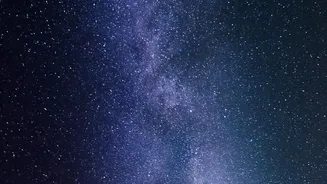
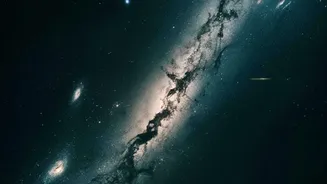
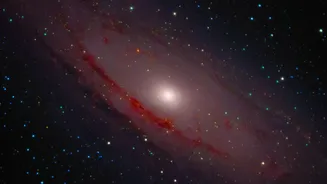
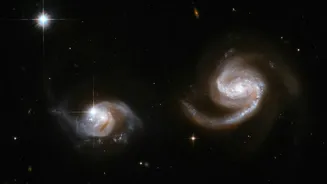
The most apparent difference between spiral and elliptical galaxies is their visual structure. Spiral galaxies, including our own Milky Way, are defined by their flat, rotating disks of stars and gas, with a bright central bulge. Most famously, they feature beautiful spiral arms that curl outwards from the centre. These arms are not solid structures but rather density waves, regions where stars and gas are temporarily compressed, much like a cosmic traffic jam. In contrast, elliptical galaxies are far simpler in shape. They are smooth, three-dimensional, and generally oval or sphere-shaped, lacking any distinct arms or disk. Their appearance can range from nearly circular to long and stretched out, like a celestial football.
The Colours of an Aging Universe
A galaxy's colour tells a profound story about the stars within it. Spiral galaxies are bustling hubs of new star formation. Their arms are rich in the gas and dust needed to create new stars. These young, massive stars burn incredibly hot and bright, giving the spiral arms a characteristic blue-white hue. Elliptical galaxies, on the other hand, are often described as 'red and dead'. They contain very little gas and dust, meaning the fuel for creating new stars was largely used up long ago. As a result, they are dominated by an older population of cooler, redder stars. This makes elliptical galaxies appear more yellowish or reddish compared to their vibrant spiral cousins.
Cosmic Motion and Dynamics
The way stars move within these galaxies is also fundamentally different. In a spiral galaxy, the vast majority of stars in the disk rotate in an orderly fashion around the galactic centre, all moving in the same direction on nearly circular orbits. This shared motion is what helps maintain the flattened, disk-like structure. The motion within an elliptical galaxy is much more chaotic. Stars travel in random, elongated orbits around the core, moving in all different directions like a swarm of bees. There is little to no organized, large-scale rotation, which is why they maintain their three-dimensional, spheroidal shape.
An Origin Story Written in the Stars
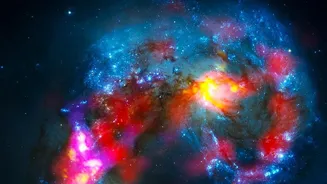
The differences in shape, colour, and motion point to very different formation histories. Current theories suggest that many elliptical galaxies are the products of major cosmic collisions. When two or more spiral galaxies merge, their gravitational interactions disrupt the orderly disks, scattering the stars into random orbits and triggering a massive burst of star formation that quickly uses up the available gas. The result is a new, larger galaxy with a disordered structure—an elliptical. Spiral galaxies, meanwhile, are thought to have formed more gently, from the slow and steady collapse of vast, rotating clouds of primordial gas, allowing them to retain their delicate disk and arm structures over billions of years.