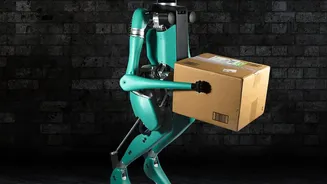







The long-promised era of humanoid robots is no longer science fiction. Machines that walk, grasp, and work like humans are clocking in at major companies, promising to solve labour shortages. But beyond the hype, the real test is just beginning.
From the Lab to the Assembly Line
Humanoid
robots are stepping out of research labs and into real-world work environments, most notably in the automotive and logistics sectors. Companies like BMW, Mercedes-Benz, and Japan Airlines are actively testing these machines for physically demanding and repetitive tasks. For example, at BMW's plant in Spartanburg, South Carolina, robots from the startup Figure have been deployed to handle sheet metal parts on the assembly line. Similarly, Mercedes-Benz has partnered with Apptronik to test its Apollo robot for delivering parts and performing quality checks in its production facilities. These pilot programs are designed to see if human-shaped robots can seamlessly integrate into infrastructure built for people, from navigating factory floors to handling components. The goal isn't just to prove the technology works, but to solve pressing real-world problems like persistent labour shortages in manufacturing.
The Productivity Puzzle
While deploying robots is one thing, ensuring they are productive is another challenge entirely. A key question for businesses is whether a humanoid robot can perform a task as efficiently and reliably as a human worker. Early results are mixed. During an 11-month deployment, a Figure robot at BMW worked 10-hour shifts, moved over 90,000 parts, and contributed to the production of 30,000 vehicles. However, analysis suggests its cycle time was slower than both the company's target and a human worker. The industry currently lacks a standard way to measure robot productivity, making it hard for businesses to calculate their return on investment. To address this, some companies are proposing new metrics, like 'Worken' or 'effective intelligent work hours', which factor in autonomous operating time and task efficiency rather than just counting the number of robots deployed. This shifts the focus from just having a robot to measuring the actual useful work it delivers.
The Maintenance Hurdle
Perhaps the biggest obstacle to widespread adoption is maintenance and reliability. Humanoid robots are incredibly complex machines with dozens of joints, motors, and sensors that must withstand thousands of hours of industrial use. Actuator reliability—the durability of the motors in the joints—is a primary concern, as failure can bring operations to a halt. Even during its successful deployment, Figure noted that the robot's forearm was a top hardware failure point. Another major constraint is battery life. Most current humanoids can only operate for a few hours before needing to be recharged, which is a significant limitation in factories that run multiple shifts. While some models feature fast charging or hot-swappable batteries, this adds another layer of complexity and cost to operations. Until these machines can operate with an uptime of 95% or higher, a standard for most industrial equipment, their economic viability remains in question.
The Road Ahead
Despite these challenges, the pace of development is rapid. Billions in venture capital are flowing into the sector, funding advances in AI, battery technology, and mechanical durability. In South Korea, a dedicated 'data factory' has been established where robots perform tasks to generate training data for more autonomous AI systems. The software that powers these robots is also evolving quickly, with AI models that allow machines to learn from realworld data and adapt to new situations with less human intervention. The focus for leading companies is now on proving the economics. The cost of a robot, estimated to be between $50,000 and $100,000, must be justified by the labour it performs over its lifespan, factoring in maintenance and supervision costs. For businesses in India and elsewhere, the key will be to move from small pilot programs to scalable, reliable deployments that deliver a clear financial return.