









From Solo Act to Ensemble Cast
Until recently, most AI systems operated like a solo performer. Think of a single, powerful large language model (LLM) trying to handle every part of a complex request, from research and analysis to writing and coding. This monolithic approach, while
impressive, often runs into limitations like computational bottlenecks or a lack of specialized knowledge. A single AI, no matter how smart, can struggle when a task requires deep expertise in multiple distinct domains. It’s like asking one brilliant musician to play every instrument in an orchestra simultaneously—possible, but not optimal.
The AI Group Chat Explained
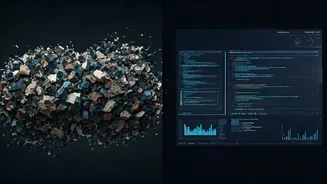
A multi-agent system is the AI equivalent of a well-coordinated team of experts. Instead of one AI doing all the work, a complex problem is broken down and distributed among multiple, specialized AI 'agents'. Each agent has a specific role, goal, and set of tools. For instance, one agent might be a 'researcher' that gathers data, another a 'coder' that writes software, a third a 'tester' that debugs it, and a 'manager' agent that oversees the entire workflow. These agents communicate and collaborate, passing information and results back and forth to achieve a common objective that would be difficult for any single agent to solve alone.
Why This Is Happening Now
The rise of multi-agent systems is driven by the increasing power and accessibility of LLMs, which now act as the reasoning 'brain' for each individual agent. Frameworks and platforms like CrewAI, LangGraph, and Microsoft's Agent Framework have also emerged, making it easier for developers to build and orchestrate these collaborative AI teams. These tools provide the structure for agents to take on roles, communicate effectively, and hand off tasks in a coordinated way, moving AI from simple, passive chatbots to active, autonomous systems that can execute complex workflows.
Putting the Agents to Work
The real-world applications are already taking shape across various industries. In logistics and supply chain management, autonomous robots in warehouses coordinate to retrieve and pack items efficiently. Financial firms use teams of agents to analyze market data, assess risks, and execute trades in real time. In healthcare, these systems can aid in everything from disease prediction to managing hospital resources like staff schedules and equipment allocation. They are also used to automate complex software development, power sophisticated cybersecurity defenses, and even manage smart energy grids.
Not All Smooth Conversation
As with any team, communication and coordination are major challenges. Ensuring dozens or even thousands of agents work together harmoniously without creating bottlenecks or deadlocks is a complex engineering problem. There's also the issue of cascading failures; if each agent in a chain has a 95% success rate, the overall reliability of the system decreases with every agent added. Furthermore, the unpredictable, or non-deterministic, nature of AI means that testing and validating the collective behavior of these systems is incredibly difficult, as they might respond differently to the same prompt on different occasions.