








From Prime Time to a Bonus Encore
Every deep-space mission is designed with a specific set of objectives and a planned operational lifespan, known as the prime mission. This is the period for which the mission is funded and during which it is expected to achieve its main scientific goals—like
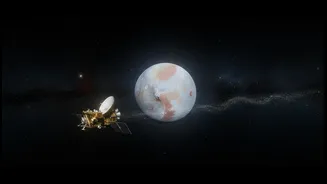
studying Jupiter or flying past Pluto. However, space is a risky business, and getting a spacecraft to its destination is a monumental achievement. So, when a probe successfully completes its primary goals and its hardware is still functioning, NASA and other space agencies often face a welcome dilemma: what to do with a perfectly good, multi-billion-dollar asset already in position? The answer is the extended mission. This 'encore' phase allows scientists to capitalize on the initial investment, gathering new data, visiting new targets, or conducting long-term observations that were never part of the original plan. It’s the ultimate expression of getting more bang for your buck, transforming these missions from single-purpose tools into long-term observatories in the far reaches of the solar system.
The Undisputed Champions of Longevity
When discussing extended missions, the conversation always begins with Voyager 1 and Voyager 2. Launched in 1977, their primary task was to tour the outer planets. Voyager 2 remains the only spacecraft to have ever visited Uranus and Neptune. After completing this 'Grand Tour' in 1989, their journey was just getting started. Their current extended phase, the Voyager Interstellar Mission, is to explore the very edge of our solar system and beyond. In 2012, Voyager 1 became the first human-made object to enter interstellar space, with Voyager 2 following in 2018. Nearly five decades after launch, they are still sending back data about the environment beyond our sun's influence, powered by radioisotope thermoelectric generators that are slowly losing power. Engineers have had to get creative, shutting down non-essential systems like heaters to conserve energy for the remaining scientific instruments, a testament to incredible ingenuity.
New Goals for Veteran Explorers
The Voyager probes are not alone in their second acts. The New Horizons spacecraft, after its spectacular flyby of Pluto in 2015, had plenty of fuel and healthy instruments. NASA approved an extended mission into the Kuiper Belt, the solar system's distant 'third zone' of icy bodies. This led to the 2019 flyby of Arrokoth, the most distant and primitive object ever explored by a spacecraft. New Horizons continues to travel through the Kuiper Belt, making unique observations of this mysterious region that are impossible from Earth. Similarly, the Juno spacecraft, which entered Jupiter's orbit in 2016, completed its primary mission in 2021. Its extended mission has transformed it into an explorer of the entire Jovian system. Its orbit has been altered to perform close flybys of Jupiter's intriguing moons, including icy Europa, volcanic Io, and giant Ganymede, providing groundbreaking data on these worlds.
The Engineering Challenge of Deep Time
Keeping these aging explorers useful is a constant battle against time and the harsh environment of space. The biggest challenge is often power. Nuclear-powered probes like Voyager lose a few watts of power each year as their plutonium fuel decays, forcing mission controllers to make difficult decisions about which instruments to shut down. For solar-powered craft like Juno, operations must be meticulously planned around available sunlight. Communication is another hurdle. It takes more than 22 hours for a signal to travel one way to Voyager 1, requiring the use of the massive antennas of the Deep Space Network. Furthermore, the technology on board is often decades old. The engineers who designed these systems may have retired, and documentation might be sparse. Keeping these vintage computers and instruments running requires a unique blend of historical knowledge and creative problem-solving from a new generation of engineers.
An Incalculable Return on Investment
While extended missions cost money to operate, the expense is a fraction of launching a new mission. They provide an incredible scientific return on the initial investment. The data collected during these bonus years often leads to unexpected discoveries that can rewrite textbooks. For example, New Horizons' recent data suggests the Kuiper Belt may be far larger than previously thought. Beyond the science, these missions are an invaluable testbed for engineering longevity. The lessons learned from keeping Voyager and other probes operational in deep space directly inform how we design future, more ambitious missions to other stars. They prove that with careful planning and clever management, a spacecraft's usefulness doesn't have to end when its first mission does.