





The Moment of Discovery
The hunt for interstellar objects begins with a wide, persistent gaze. Automated sky surveys, like the NASA-funded Asteroid Terrestrial-impact Last Alert System (ATLAS), are our planet's robotic night watch. These systems scan the entire sky repeatedly,
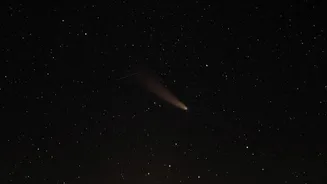
taking images and comparing them to detect anything that moves against the backdrop of stationary stars. On July 1, 2025, a telescope in Chile, part of the ATLAS network, flagged a faint object moving with unusual speed and direction. This initial alert, sent to the Minor Planet Center, triggered a global cascade of follow-up observations from observatories worldwide, all racing to get a better look.
The Tell-Tale Hyperbolic Path
The key to identifying an interstellar visitor lies in its trajectory. Objects from our solar system, even comets from its farthest reaches, are gravitationally bound to the Sun and travel in closed elliptical orbits. Interstellar objects, however, are just passing through. They arrive with too much speed to be captured by the Sun's gravity. As a result, they follow a unique, open-ended path called a hyperbolic trajectory. Astronomers confirmed this for 3I/ATLAS by collecting positional data and calculating its orbit. Its path was so extremely hyperbolic that it was clear it came from interstellar space and would never return, making it a one-time visitor.
A Coordinated Global Effort
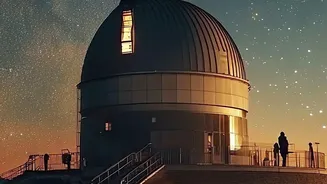
Once an object is flagged as potentially interstellar, it becomes a top priority. A single telescope can't do the job alone. A worldwide network of ground-based and space-based observatories coordinates to track the object continuously. Powerful telescopes like those at Las Cumbres Observatory, as well as assets from the European Space Agency, were quickly pointed at 3I/ATLAS. Even NASA's Hubble and James Webb Space Telescopes were tasked with observing the comet. This collaborative effort is crucial because the object is moving fast and the window for observation is limited. By combining data, scientists create highly precise orbital calculations to predict its future path and plan further studies.
Decoding the Comet's Secrets with Light
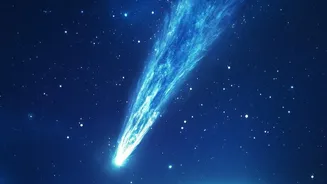
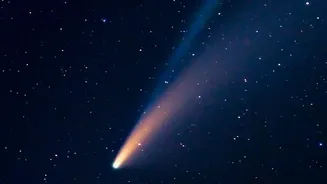
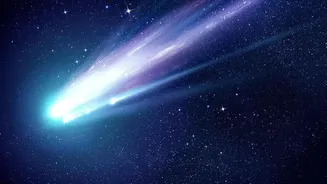
Tracking the path is just the first step. The real prize is understanding what the comet is made of. To do this, astronomers use a technique called spectroscopy. By passing the comet's faint light through a spectroscope, they can spread it into a rainbow-like spectrum. Different molecules and elements absorb and emit light at specific wavelengths, creating a unique chemical fingerprint. For 3I/ATLAS, spectroscopy revealed a coma—a cloud of gas and dust—rich in carbon dioxide and carbon monoxide, especially when it was far from the Sun. This analysis provides precious clues about the chemical environment of the star system where it was born.
Why the Chase Is Worth It
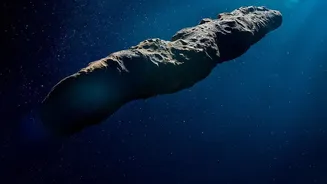
The intense effort to follow objects like 3I/ATLAS is driven by a quest for fundamental knowledge. These comets are pristine samples of material from other planetary systems. They are frozen time capsules that carry direct information about the building blocks of planets around other stars. By studying their composition, speed, and behaviour, scientists can test and refine theories about how planets form across the galaxy. Each new interstellar visitor, from 1I/ʻOumuamua to 2I/Borisov and now 3I/ATLAS, adds another crucial data point, helping us understand our own solar system's place in the cosmic tapestry.