



A Visitor from Deep Space
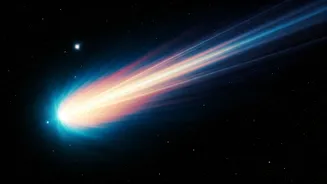
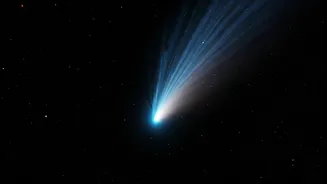
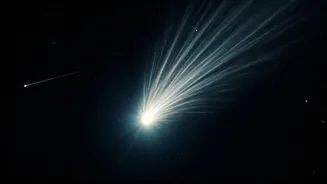
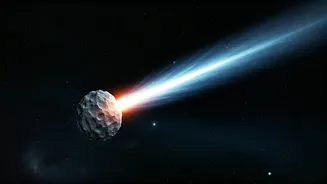
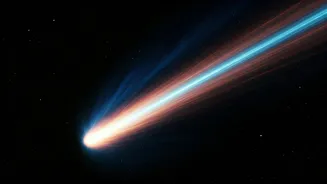
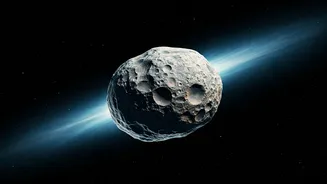
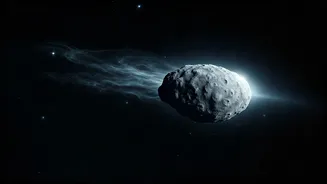
Our solar system gets visitors from time to time, but most are familiar neighbors—asteroids and comets from our own cosmic backyard. That’s what made the detection of 3I/ATLAS in July 2025 so thrilling. Its trajectory confirmed it was an interstellar
object, only the third one ever identified, meaning it came from another star system. Unlike a tourist just passing through, this comet didn’t just wave from a distance; its unusual brightness gave scientists an unprecedented chance to study a messenger from an unknown part of the galaxy. While our first two interstellar guests, ‘Oumuamua and Borisov, were fascinating, 3I/ATLAS offered a much clearer look, thanks to powerful tools like the James Webb Space Telescope.
How to Read a Comet's Birth Certificate
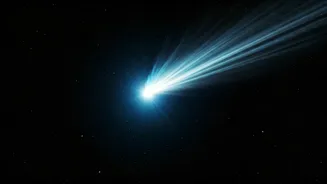
But how do you determine the age of an object that has been wandering through the void for potentially billions of years? A comet doesn't come with a date stamped on its surface. The secret lies in its chemistry. When a comet gets close to a star, its ice turns to gas, creating a glowing halo called a coma. By analyzing the light from this coma with instruments called spectrographs, scientists can identify its chemical ingredients. They pay special attention to isotopes—different versions of the same element that have slightly different masses. The ratio of these isotopes, like heavy hydrogen (deuterium) to regular hydrogen, acts as a fingerprint, revealing the conditions under which the comet formed. A high ratio of deuterium, for example, points to an origin in an extremely cold environment.
Evidence for an Ancient Origin
The analysis of 3I/ATLAS revealed a chemical fingerprint unlike anything seen in our own solar system. Observations showed exceptionally high levels of deuterium, suggesting it formed in a place much colder than the region that gave birth to our own comets. Based on this and other chemical clues, researchers published studies in the journal Nature suggesting a startling possibility. The comet could be up to 12 billion years old. To put that in perspective, our solar system is a relative newcomer at about 4.6 billion years old. This ancient visitor might be a relic from a period known as the "cosmic noon," a time around 10 billion years ago when star formation across the universe was at its peak. It may be a preserved fragment from a planetary system that formed, and perhaps vanished, long before the Sun ignited.
The All-Important 'Maybe'
This is where the headline's crucial final word comes in: "Maybe." Science is a process of evidence and debate, not proclamation. The very scientists leading this research are careful to highlight the uncertainties. Martin Cordiner of NASA's Goddard Space Flight Center called 3I/ATLAS "maybe... the oldest object to have been observed in our solar system," but he also noted there could be "edge-case scenarios" that offer alternative explanations for its strange chemistry. This isn't a sign of weakness but a hallmark of the scientific method. While the evidence strongly suggests an ancient, interstellar origin, researchers must rule out all other possibilities before a "maybe" can become a certainty. Other astronomers have hailed the findings as unprecedented, with one noting it's a "safe bet that it's older than anything that formed in the solar system," even if its exact age remains uncertain.
Why This Galactic Fossil Matters
Even if its exact age is still debated, 3I/ATLAS represents a monumental discovery. Comets from our own solar system are like family photo albums, telling us about our own origins. But an interstellar comet is like finding a photo album from a completely unknown family on another continent. It provides a rare, direct look at the building blocks of planets around other stars, in other parts of the galaxy, and potentially from other eras of cosmic history. By studying these visitors, we can learn whether the ingredients that formed our solar system are common or rare throughout the Milky Way. Each interstellar object is a precious, fleeting data point, helping us piece together the grand story of how star systems, and perhaps even the raw materials for life, are distributed across the galaxy.