


What Exactly is the Solar Corona?
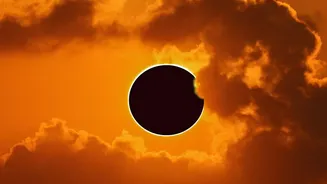
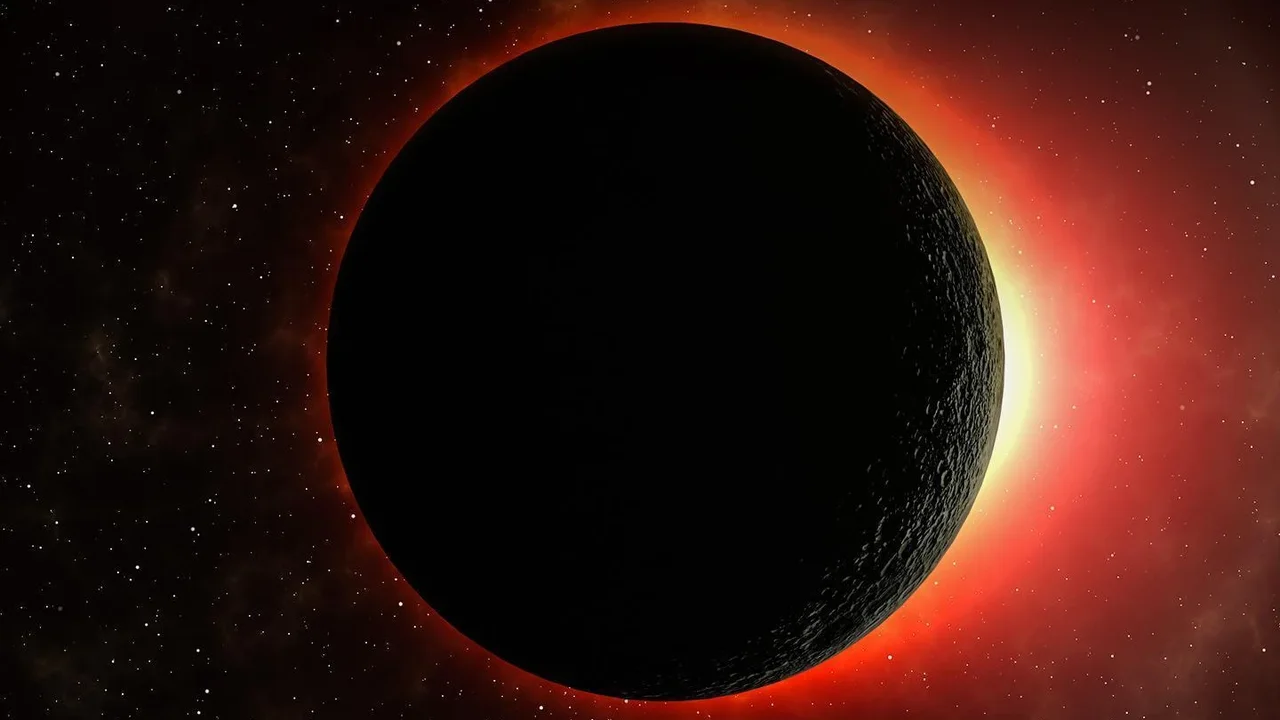
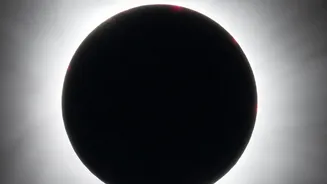
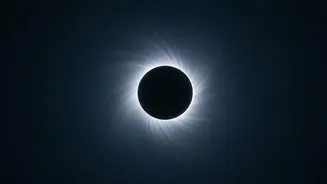
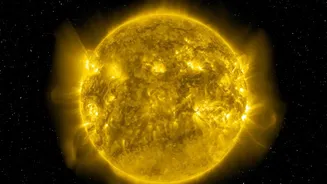
The solar corona is the outermost layer of the Sun's atmosphere, a vast expanse of superheated gas, or plasma, that stretches millions of kilometres into space. Normally, this faint halo is completely invisible, drowned out by the intense brightness of the Sun's surface,
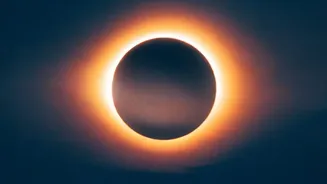
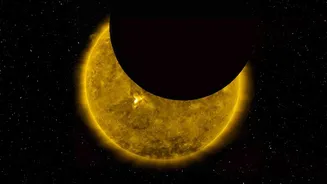
the photosphere. It’s only during the rare moments of a total solar eclipse, when the Moon perfectly blocks the Sun's face, that the corona’s ghostly, wispy streamers are revealed to observers on Earth. These beautiful structures are not random; they are shaped by the Sun’s powerful and complex magnetic fields.
The Great Solar Paradox
One of the most profound mysteries in astrophysics is the coronal heating problem. Logically, the temperature should decrease as you move away from a heat source. Yet, the Sun defies this. While the Sun's surface simmers at around 5,500 degrees Celsius, the corona sizzles at an astonishing 1 to 2 million degrees Celsius, hundreds of times hotter. Scientists are still working to understand exactly how this happens. Leading theories involve energy being transferred from the Sun's interior via magnetic waves or countless tiny explosions, sometimes called 'nanoflares', that release bursts of heat into the atmosphere.
An Opportunity for Global Science
The 2026 eclipse, with a path of totality over Greenland, Iceland, and Spain, provided a crucial, albeit brief, window for research. For up to two minutes and 18 seconds, scientists could study the lower and middle parts of the corona, a region notoriously difficult to observe even with specialized instruments called coronagraphs. This event became a massive international effort. Research teams deployed along the eclipse path in Spain and Iceland, using advanced spectrometers and cameras to capture the corona in unprecedented detail. By comparing these ground-based observations with computer models, scientists can test and refine their understanding of the Sun's magnetic environment.
Eyes in the Sky
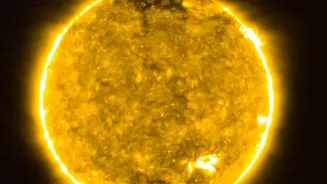
The effort wasn't limited to the ground. Above the clouds, NASA flew its WB-57 high-altitude research aircraft along the eclipse path to extend the viewing time to nearly three minutes. Soaring at 50,000 feet, its cameras captured high-resolution images in wavelengths that are absorbed by the atmosphere, providing a clearer view of the corona's temperature and structure. These airborne missions worked in concert with space-based observatories. Spacecraft like the European Space Agency's Solar Orbiter and NASA's Parker Solar Probe provided data from different vantage points, helping to build a more complete, three-dimensional picture of the corona and its activity.
Why It Matters for Earth
Studying the corona isn't just about solving a cosmic puzzle; it has practical implications for us on Earth. The corona is the birthplace of the solar wind, a constant stream of charged particles flowing from the Sun. It is also where violent events like coronal mass ejections (CMEs) originate. These massive eruptions of plasma can travel through space and, if aimed at Earth, disrupt our satellites, communication systems, and even power grids. Understanding the corona is the key to improving our ability to forecast this 'space weather' and protect our technologically dependent society.