







An Immense Swarm of Ice
From Earth, Saturn’s rings look like a smooth, solid disc—a perfect celestial halo. But if you could fly a spacecraft through them, as NASA's Cassini probe famously did, you’d discover they are not solid at all. Instead, they are a colossal, flat swarm
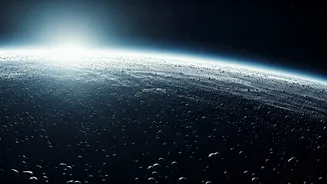
of individual particles. An estimated 99.9% of these particles are made of water ice, with a tiny fraction of rocky material and dust mixed in. These aren't just tiny specks; the objects range in size dramatically. Some are as small as a grain of sand, while others are the size of a car or even a house. It’s the collective reflection of sunlight off these billions of icy bodies that creates the bright, seemingly solid appearance we see from afar. Imagine a cloud of countless tiny mirrors, all orbiting Saturn in a vast, thin sheet, and you’re starting to get the picture.
The Illusion of Solidity
The word "fabricate" in the headline is surprisingly accurate. The view of solid rings is an optical illusion created by scale and distance. The main ring system stretches up to 282,000 kilometres in diameter, wide enough to fit almost the entire distance between the Earth and the Moon. Yet, for all their immense width, the rings are astonishingly thin. In most places, they are only about 10 metres to 1 kilometre thick. This extreme thinness is what makes them appear so sharp and defined. When we look at them, our eyes blend the billions of separate, orbiting particles into a single, continuous structure, much like how individual pixels on a television screen blend together to form a clear image. Each particle is on its own separate orbit, but they travel together in a cosmic traffic jam, creating the grand illusion of a solid ring.
The Grand Architecture
Saturn’s rings are not one single band. They are a highly complex system composed of seven main rings, which are labelled alphabetically in the order they were discovered (D, C, B, A, F, G, and E). The most prominent and visible rings are A and B, which are separated by a 4,800-kilometre-wide gap known as the Cassini Division. This gap, which looks like a dark band, is not entirely empty but contains far less material. Zooming in further, scientists have found that these main rings are themselves made up of thousands of smaller, tightly packed ringlets. The structure is intricate, with ripples, waves, and spokes that change over time. This complex architecture is not random; it’s a direct result of the gravitational forces at play in the Saturnian system.
Cosmic Shepherds at Work
So what holds this impossibly thin, wide system of particles together? The answer lies in gravity, specifically from Saturn itself and its many moons. Saturn’s immense gravity keeps the particles from flying off into space, forcing them into a flat orbital plane around its equator. More fascinatingly, dozens of tiny “shepherd moons” orbit within or near the rings, acting as gravitational sculptors. Moons like Prometheus and Pandora, which orbit near the F ring, use their gravitational pull to keep the ring particles in a narrow, defined path. They nudge stray particles back into line, creating sharp edges and preventing the rings from spreading out. These moons are the cosmic architects that maintain the beautiful, delicate structure of the rings, clearing gaps and corralling the icy debris into the stunning patterns we observe.
A Temporary Cosmic Marvel
For a long time, astronomers thought the rings were as old as Saturn itself. However, data from the Cassini mission dramatically changed this view. The rings are surprisingly clean and bright, suggesting they haven't been accumulating cosmic dust for billions of years. The prevailing theory now is that the rings are a relatively recent addition, perhaps only 10 to 100 million years old—meaning they may have formed when dinosaurs still roamed the Earth. They likely originated from one or more icy moons that were shattered by a collision or ripped apart by Saturn’s gravity. Even more startling is the discovery that the rings are not permanent. A phenomenon known as “ring rain” is causing the icy particles to be pulled inward by Saturn's gravity and magnetic field, falling onto the planet. At the current rate, scientists estimate the rings could disappear entirely within the next 100 to 300 million years. We are lucky to be living in an era where we can witness this magnificent, but fleeting, cosmic wonder.